

RF Polyphase Channelizer
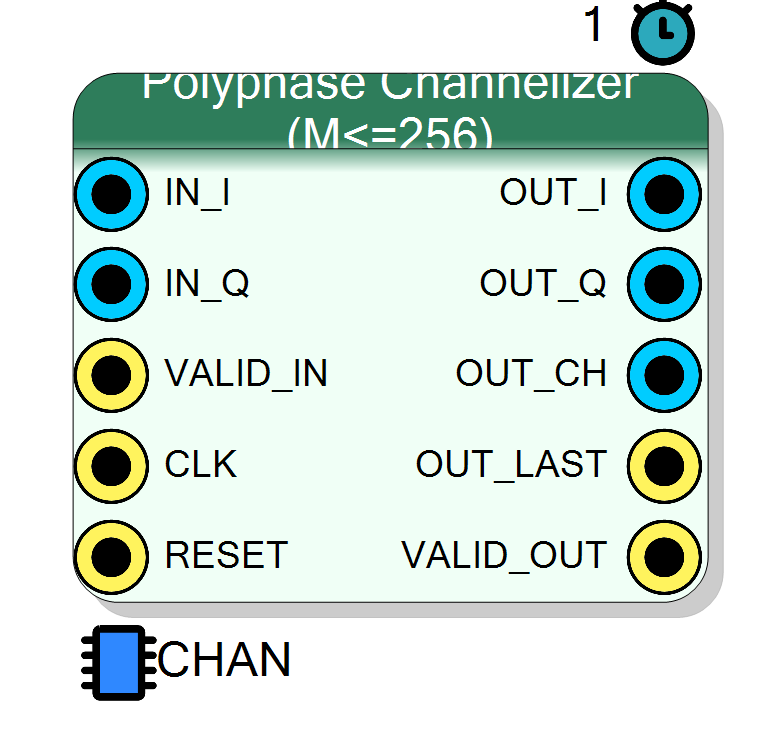
KriaTest polyphase filter-bank channelizer: splits a 250 MSPS complex stream into M = 8..256 channels (power of 2, runtime) with an 8-tap/phase prototype loaded at run time, and streams one channel per clock (TDM) with the channel index and an end-of-frame flag.
Introduction
Port of the KriaTest poliphase_channelizer (Vitis HLS DATAFLOW, silicon
proven on KR260): commutator + polyphase FIR with time-shared MACs, ping-
pong reorder, radix-2 single-path delay-feedback FFT with runtime bypass
of the leading stages, formatter with channel index. The core source is
verbatim; this block adds the control plane KriaTest ran in software
(clear/load sequencing, auto-restart, coefficient RAM) as a VHDL wrapper,
and optionally KriaTest’s chan_glue (Q3.21 -> int16 scaling).
IN_I/IN_Q --FIFO--> [ FIR polyphase -> reorder -> SDF FFT -> format ] --chan_glue--> OUT_I/OUT_Q
^ coeffs (endpoint memory, MaxChannels*8 x 18) OUT_CH / OUT_LAST
Pin Description
Properties
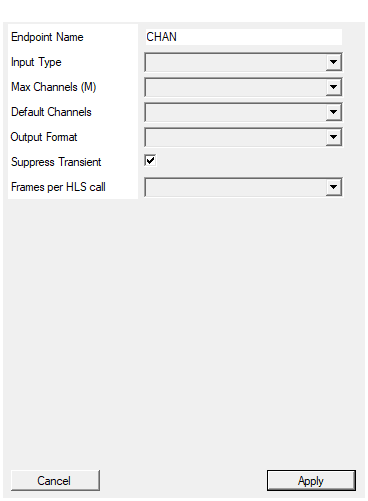
Name of the register endpoint. Registers are REG_
CHAN).
Default: CHAN
Complex I/Q input (KriaTest default, REAL_INPUT=0) or real-only input (REAL_INPUT=1: half the FIR MACs).
Complex (default) or Real (REAL_INPUT=1, half the FIR MACs).
Default: Complex
Options: Complex Real
Largest number of channels M (power of 2, 8..256). Sizes the hardware (MAX_CHANNELS / LOG2_MAX: SDF stages, history RAM, coefficient window = M*8 words). The runtime M is 2^LOG2_M (register), up to this value.
8..256, power of 2 (MAX_CHANNELS / LOG2_MAX): only the SDF stages that can be active are built.
Default: 256
Options: 8 16 32 64 128 256
M used while register LOG2_M is 0 (i.e. right after reset, before software writes it). Clamped to Max Channels.
M whileLOG2_M = 0.
Default: 256
Options: 8 16 32 64 128 256
int16 (chan_glue): Q1.15 per channel, gain-compensated by 2^(LOG2_M-COEF_SHIFT), saturated, the format Channel Trigger / Multichannel Delay Buffer expect (KriaTest chain). Raw Q3.21: the 24-bit HLS output, gain 2^(COEF_SHIFT-LOG2_M).
int16 via chan_glue (the format Channel Trigger / Delay Buffer expect) or raw Q3.21.Default: int16 (chan_glue)
Options: int16 (chan_glue) Raw Q3.21
Drop the first M-1 outputs after every clear (they are spurious and form exactly the first partial frame). If off they are passed and STATUS b3 flags them.
Drop the first M-1 outputs after a clear.Default: True
nframes of each HLS call (the core auto-restarts; one few-clock bubble per call is absorbed by the input FIFO). KriaTest used the maximum, 65535.
nframes per HLS call (1024 .. 65535).Default: 65535
Options: 1024 4096 16384 65535
Usage
Registers (endpoint = EndpointName, KriaTest page CHAN)
| register | access | meaning |
|---|---|---|
CTRL |
W | b1 clear, b2 load_coeffs (rising edge: abort + clear + reload, as KriaTest always paired them); b0 shadow |
LOG2_M |
W | 3 .. log2(MaxChannels); 0 = Default Channels property. A change clears + reloads AUTOMATICALLY |
COEF_SHIFT |
W | chan_glue shift = 6 - (LOG2_M - COEF_SHIFT); must be the prescaling of the loaded prototype |
STATUS |
R | b0 running, b1 clearing, b2 overflow (SAT_COUNT /= 0), b3 settling, b4 drop, [11:8] effective log2 M |
SAT_COUNT |
R | chan_glue saturated words |
DROP_COUNT |
R | input samples lost on a full input FIFO |
memory COEFFS |
RW | MaxChannels*8 words, coefficient in [17:0] (Q1.17), POLYPHASE order coeffs[p*8+t] = h[t*M+p], prototype pre-scaled by 2^COEF_SHIFT (KriaTest dsp.py coeff_words) |
Procedure
- write the coefficient window, 2. write
COEF_SHIFT, 3. writeLOG2_M(auto clear) or pulseCTRL.b2, 4. waitSTATUS.b0. The first M-1 outputs after a clear are spurious; with Suppress Transient they are dropped (they are exactly the first partial frame).
Notes
- Vitis stall pipelines hold the last ~19 samples of a burst inside the core until more input arrives (continuous streams are unaffected).
- One HLS call = FramesPerCall frames; the few-clock restart bubble is absorbed by a 64-deep input FIFO, overflow is counted in DROP_COUNT.
Resources & Timing
-
Latency: M-1 samples (SDF chain) + pipeline
-
Throughput: One sample per clock in, one channel sample per clock out
MaxChannels=256: 34 BRAM18 + 56 DSP + ~20.5k FF / 21.3k LUT (core, 3.14 ns est.) + 2 x 2048x18 coefficient RAMs in the wrapper. Verified: C core with the injected defines bit-exact vs KriaTest (MAX 256) and generated RTL vs golden in GHDL for M<=16/32/256 (tb/kria_channelizer).