
Violet Noise
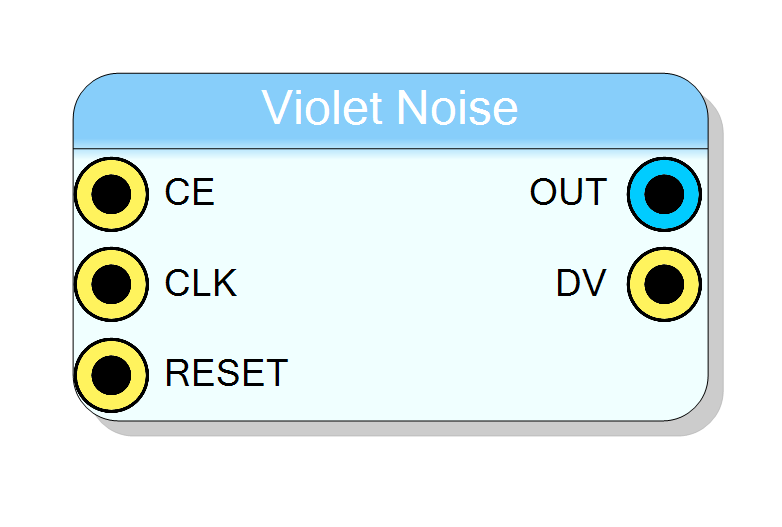
Violet (purple) noise source, +6 dB/octave, one sample per CE clock: the first difference of the embedded white xoshiro256** source. The halved difference always fits the output width – no saturation, no multipliers. Auto-random per-instance seed, RESET restarts the sequence.
Introduction
Violet noise rises at +6 dB per octave ($f^2$ PSD) – the spectrum of differentiated white noise, useful to stress high-frequency behavior (e.g. emulating the noise floor shape after an analog differentiator or testing HF rejection). The block computes $v[n] = (x[n] - x[n-1])/2$ on the embedded white source.
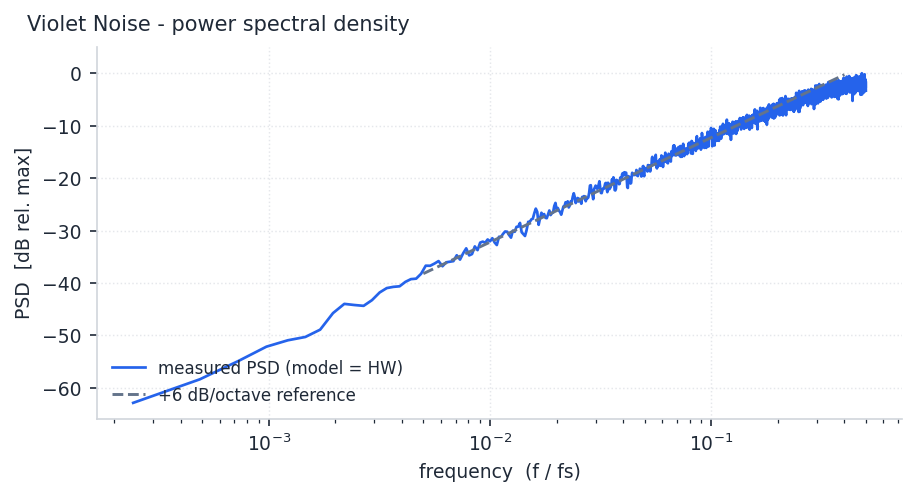
Measured on the bit-exact model the hardware is verified against; the dashed line is the ideal +6 dB/octave slope.
Pin Description
Properties
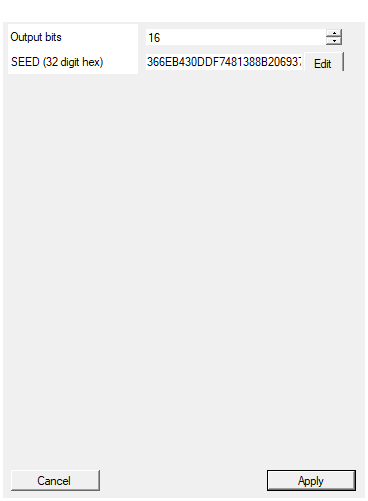
Width of the OUT word (2..32), signed.
Output width (2..32), signed.Default: 16
Range: 2 – 32
Seed of the embedded white generator (128 bit hex), expanded internally with SplitMix64. Auto-randomized when the component is created, so multiple instances produce independent noise; editable for reproducible runs. RESET restarts the sequence. Violet noise, +6 dB/octave (first difference of white noise).
128-bit seed of the embedded white generator (auto-randomized at placement, editable).Default: 366EB430DDF7481388B20693794DE31A
Usage
One sample per CE clock, one clock latency. CE defaults to ‘1’.