
Convolution point (1 MAC, loadable kernel)
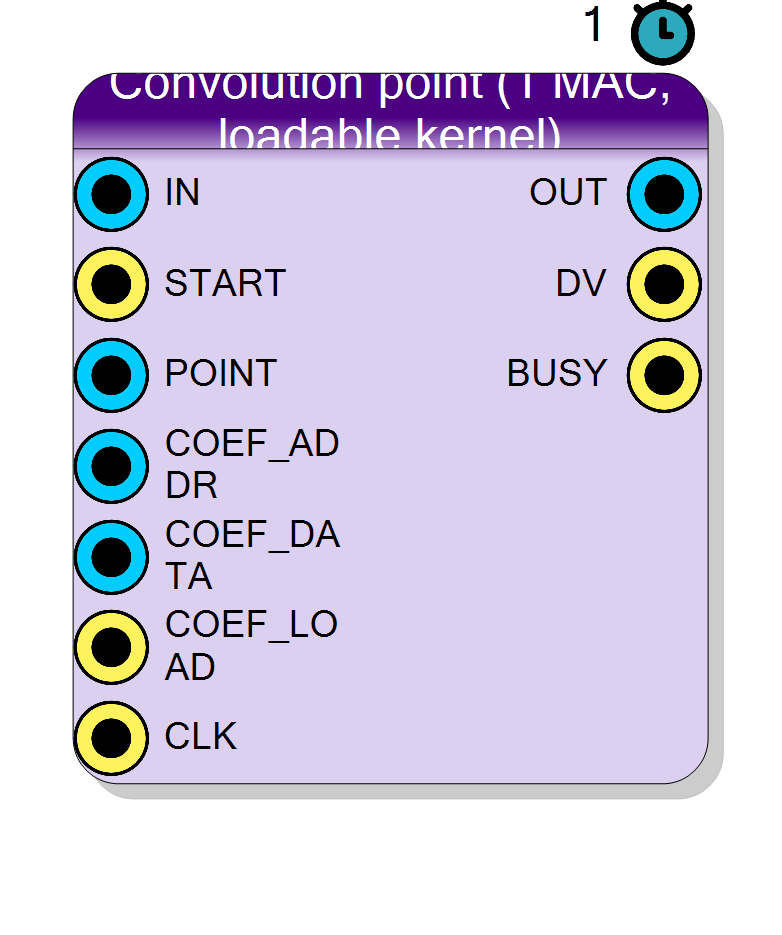
Computes a SINGLE point of the convolution between a K-sample input window and a kernel loadable at run time (COEF_ADDR / COEF_DATA / COEF_LOAD). The computed point is selected by the POINT input, sampled on the START edge. One MAC; result ready right after the K-th sample.
Introduction
Runtime-configurable version of Convolution point (1 MAC, fixed kernel):
- kernel coefficients are written into an internal RAM through
COEF_ADDR/COEF_DATA/COEF_LOAD(one-clock pulse per write); - the computed point comes from the
POINTinput pin, latched at theSTARTrising edge - so the point can change on every trigger.
$$ y[\text{POINT}] = \sum_{m=0}^{K-1} x[m] \cdot h[\text{POINT}-m] $$
Pin Description
Properties
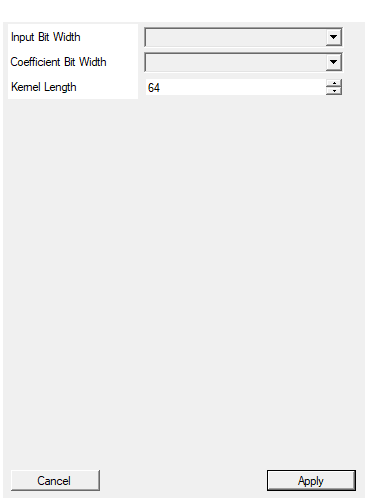
Bit width of the signed input samples.
Bit width of the signed input samples: 16, 24 or 32.Default: 16
Options: 16 24 32
Bit width of each kernel coefficient (signed). Width of the COEF_DATA input.
Bit width of each kernel coefficient (signed), 8..32. Width of COEF_DATA.Default: 16
Options: 8 10 12 14 16 18 20 24 28 32
Number of kernel coefficients K (coefficient RAM depth). The IP consumes K samples after START. POINT selects the computed convolution point (0 .. 2K-2).
Number of kernel coefficients K (2..4096) = coefficient RAM depth.Default: 64
Range: 2 – 4096
Loading the kernel
text
for k in 0 .. K-1:
COEF_ADDR <= k
COEF_DATA <= h[k]
COEF_LOAD <= 1 for one clock
Writes are honoured on every clock, in any state; for a coherent result avoid rewriting taps while BUSY = 1.
Selecting the point
Drive POINT with the desired index (0 .. 2K-2) before raising START:
the value is sampled once at the START edge, so it can be driven from a
register and changed between triggers with no glitches.
Timing and width
RUN lasts K clocks (one sample per clock); DV pulses one clock after the last sample. Output width:
$$ \text{OUT_BITS} = \text{InputSize} + \text{CoefSize} + \lceil \log_2 K \rceil $$