
Float Min TM
Returns the selected IEEE-754 floating point VALUE, not a boolean flag. Needs no floating point IP and no DSP: the ordering of IEEE-754 numbers matches the ordering of their bit patterns once mapped through a monotonic key, so a single integer comparator does the whole job.
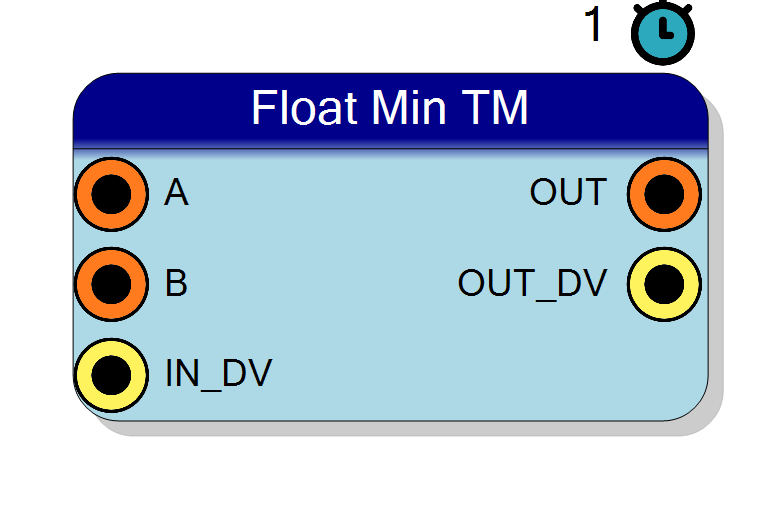
Introduction
The block computes
$$ \mathrm{OUT} = \min(A, B) $$
and outputs the selected value. This is the difference with the boolean comparator blocks (Equal, Greater, Smaller, …), which only report the outcome of the test on a 1-bit flag: here the winning operand itself comes out.
The integer counterpart of this block is Select Smaller, already in this plugin.
All ports are IEEE-754 numbers, single (32 bit) or double (64 bit) precision, selected by the FloatType property.
This is the time-multiplexed variant: the A port carries TM samples packed
side by side in one wide vector and one comparator is generated per slot, so all
the slots are processed in the same clock cycle. Operand B can either be time
multiplexed as well or a single scalar compared against every slot, selected by
the B_IsTM property.
Pin Description
Properties
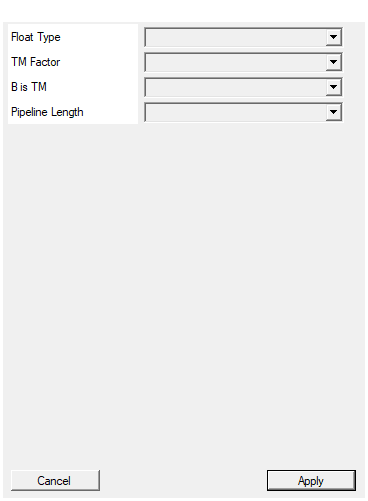
IEEE-754 precision of every port: Single (32 bit) or Double (64 bit).
IEEE-754 precision used by every port:
- Single – 32 bit (1 sign, 8 exponent, 23 mantissa)
- Double – 64 bit (1 sign, 11 exponent, 52 mantissa)
Default: Single
Options: Single Double
Time multiplexing factor
Time multiplexing factor: 4, 8, 16 or 32 samples packed per port. One comparator is generated per slot.Default: 4
Options: 4 8 16 32
YES: operand B is time multiplexed like A. NO: it is a single scalar value compared against every TM slot.
- YES – operand
Bis time multiplexed and is used slot by slot - NO – operand
Bis a single scalar applied to every slot
Default: YES
Options: NO YES
Number of output register stages, i.e. the latency in clock cycles. 0 makes the block purely combinational.
Number of output register stages, i.e. latency in clock cycles (0 to 8). 0 makes the block purely combinational. Does not affect the result.Default: 1
Options: 0 1 2 3 4 5 6 7 8
Functional description
$$ \mathrm{OUT} = \min(A, B) $$
where
A– IEEE-754 input operandB– IEEE-754 input operandOUT– the selected operand, same format as the inputs
How the comparison is done
IEEE-754 was designed so that, within one sign, the ordering of the numbers is the same as the ordering of their raw bit patterns read as integers. Mapping the pattern through
$$ \mathrm{key}(x) = \begin{cases} \lnot x & \text{sign bit set}\ x \lor 2^{W-1} & \text{otherwise} \end{cases} $$
extends that property across the sign, so ONE unsigned integer comparison orders any two floats exactly. The block therefore costs a comparator and a multiplexer: no floating point IP, no DSP slice and no multi-cycle FPU latency.
Special values
- NaN – follows the IEEE-754
minNum/maxNumconvention: a NaN operand is ignored and the other one is returned. For Clamp, a NaN bound is ignored, while a NaN onINpasses through unchanged. - Infinities – ordered normally, so $-\infty$ is the smallest value and $+\infty$ the largest.
- Signed zeros – ordered $-0 < +0$, so Min returns $-0$ and Max returns $+0$. The two are numerically equal; this is only a deterministic tie break.
Time multiplexing
The wide ports pack TM samples starting from the least significant bits:
bits [W-1 : 0] -> slot 0
bits [2W-1 : W] -> slot 1
...
bits [TM*W-1 : (TM-1)*W] -> slot TM-1
where W is the width of one sample. The slots are INDEPENDENT: one comparator
is generated per slot and they never interact.
Implementation
Plain VHDL (Resources/Code/float_minmax.vhd), shared with the other operations of
the same kind through the OP generic – the same way comparator.vhd already backs
Equal, Greater and Smaller. No HLS is involved, so this block builds without Vitis
HLS installed, and it uses no DSP slice.
Latency
PipelineLength sets the number of output register stages, i.e. the latency in clock cycles. Set it to 0 for a purely combinational block; raise it to help timing closure at high clock rates. It never changes the result.
Typical use cases
- Enforcing an upper bound on a signal
- Selecting the smaller of two measurements
- Running minimum, when combined with a feedback path