
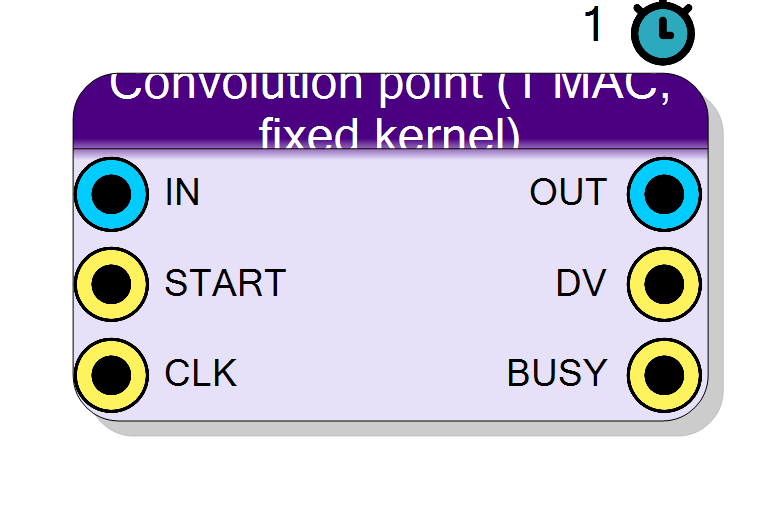
Convolution point (1 MAC, fixed kernel)
Computes a SINGLE point of the convolution between a K-sample input window and a fixed kernel, with exactly one MAC. On START the block consumes K samples (one per clock) and accumulates on the fly; the result is ready with a DV pulse right after the last sample. The kernel and the computed point are picked in the Convolution Designer GUI, which shows the whole offline convolution and lets you drag the point marker.
Introduction
Where the full-graph variant produces every $y[p]$, this IP computes only the one point you care about:
$$ y[p] = \sum_{m=0}^{K-1} x[m] \cdot h[p-m] $$
with $p$ fixed at synthesis time. Because the MAC happens while the samples stream in (at sample $m$ the block adds $x[m] \cdot h[p-m]$ when the index is valid), the block needs no sample memory and only one multiplier, and the answer is ready one clock after the $K$-th sample.
Typical use: matched-filter peak sampling, correlation at a known delay, centre-of-kernel energy estimate.
Double-clicking opens the Convolution Designer in point mode: load and quantise the kernel, pick a test signal (or load your own), see the full offline convolution and drag the marker to choose the point the hardware will compute. The quantised kernel can be exported as CSV (decimal or hex).
The designer includes the spectroscopy kernel generator: presets (triangular, rectangular, parabolic, cusp, cusp/Gaussian with flat top, CR-RC^n, Savitzky-Golay smooth/derivatives, Gaussian derivative of order n, Morlet, CFD, boxcar difference), the parametric trapezoid family with shaping time, edge concavity and optional zero-area parabolic lobes (before/after/both, adjustable overlap), and the preamp deconvolution panel (exponential rise + up to 3 decay constants, pole-cancelling FIR with optional residual sharpening) that can be folded into any generated or loaded kernel.
Pin Description
Properties
Bit width of the signed input samples.
Bit width of the signed input samples: 16, 24 or 32.Default: 16
Options: 16 24 32
Bit width of each kernel coefficient (signed).
Bit width of each quantised kernel coefficient (signed), 8..32.Default: 16
Options: 8 10 12 14 16 18 20 24 28 32
Number of kernel coefficients K. The IP captures K samples after START. Mirrored from the Convolution Designer.
Number of kernel coefficients K (2..4096). Mirrored automatically from the Convolution Designer.Default: 64
Range: 2 – 4096
Quantised kernel + designer state, produced by the Convolution Designer.
Index of the convolution point computed by the hardware (0 .. 2K-2). Picked in the Convolution Designer.
The convolution point computed by the hardware (0 .. 2K-2). Picked graphically in the Convolution Designer (hidden property, mirrored on save).Default: 63
Range: 0 – 8190
Timing
| Phase | Duration | Description |
|---|---|---|
| IDLE | - | waiting for START rising edge |
| RUN | K clocks | consumes one sample per clock, MACs on the fly |
DV pulses one clock after the last consumed sample; OUT holds the
result until the next completion. BUSY is high during RUN.
Output width
$$ \text{OUT_BITS} = \text{InputSize} + \text{CoefSize} + \lceil \log_2 K \rceil $$
Choosing the point
Point index range is $0 \ldots 2K-2$:
- $p < K-1$ : the kernel only partially overlaps the beginning of the window,
- $p = K-1$ : full overlap (this is the “matched filter aligned” point),
- $p > K-1$ : partial overlap with the end of the window.