
RF Complex + Constant (DC offset)
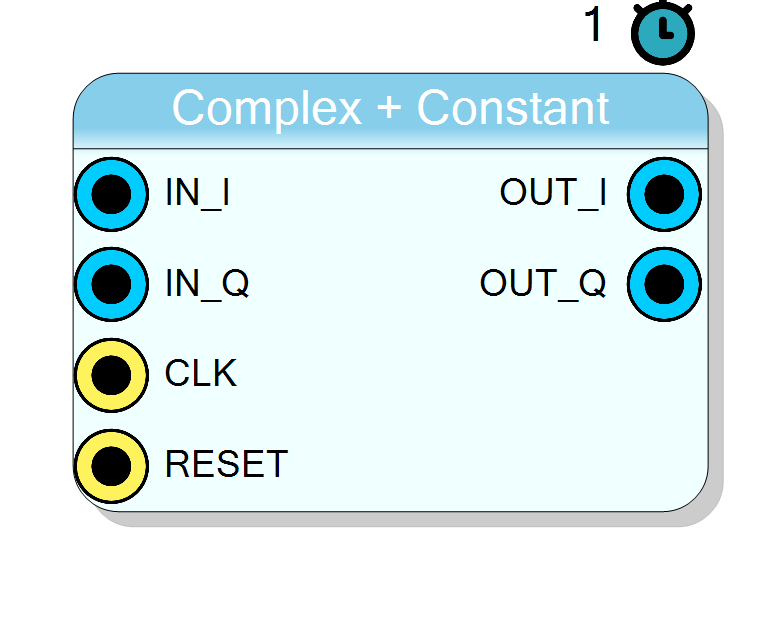
Adds a fixed complex constant (OffsetI, OffsetQ) to a complex I/Q stream. Typical use: inject or correct a DC term on the baseband signal, or re-center a bipolar stream around a chosen operating point.
Introduction
The Complex + Constant block adds a compile-time complex constant to each incoming sample:
OUT_I[n] = IN_I[n] + OffsetI
OUT_Q[n] = IN_Q[n] + OffsetQ
The two offsets are entered as signed integer text properties
(OffsetI, OffsetQ) and baked into the netlist as internal constant
signals. They are not exposed as fabric pins: the plugin sign-extends each
value to OffsetSize bits, packs it as a VHDL constant and wires it to an
ap_stable port on the HLS core.
Pin Description
IN_I + OffsetI. Signed,
max(InputSize, OffsetSize) + 1 bits.
IN_Q + OffsetQ. Signed,
max(InputSize, OffsetSize) + 1 bits.
Properties
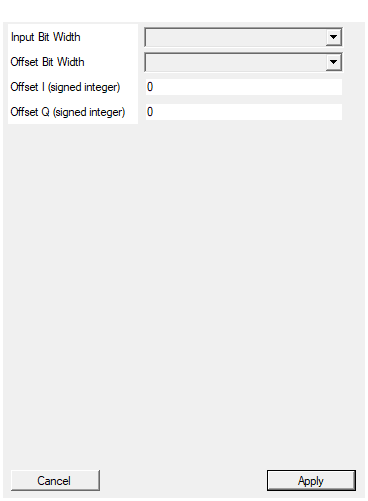
Bit width of each I/Q input (signed).
Bit width of each signed I / Q input sample. Range 4 to 32, default 16.Default: 16
Options: 4 5 6 7 8 9 10 11 12 13 14 15 16 17 18 19 20 21 22 23 24 25 26 27 28 29 30 31 32
Bit width of each offset constant (signed).
Bit width of each signed offset constant. Range 4 to 32, default 16. Must be wide enough to hold the offset values you enter.Default: 16
Options: 4 5 6 7 8 9 10 11 12 13 14 15 16 17 18 19 20 21 22 23 24 25 26 27 28 29 30 31 32
Constant added to the I channel.
Constant added to the I channel, entered as a signed decimal integer. Default 0. Encoded as a two’s-complementOffsetSize-bit constant.
Default: 0
Constant added to the Q channel.
Constant added to the Q channel, entered as a signed decimal integer. Default 0. Encoded as a two’s-complementOffsetSize-bit constant.
Default: 0
Usage
Mathematical model
OUT = IN + OFFSET (per channel, signed integer add)
The add is done at full precision, so the result can grow by at most one bit versus the wider of the two operands.
Bit widths
Data and offsets are signed two’s complement.
IN_I,IN_Q: signedInputSizebits.OffsetI,OffsetQ: signedOffsetSize-bit constants (internal).OUT_I,OUT_Q: signedmax(InputSize, OffsetSize) + 1bits.
The +1 guard bit guarantees the sum never overflows regardless of the
relative sizes of the input and the constant.
Constant encoding
Each offset property is parsed as a signed decimal integer, masked to
OffsetSize bits (two’s complement) and emitted as a hex constant in the
VHDL. Choose OffsetSize large enough to represent the offset you type:
a value outside the signed OffsetSize-bit range wraps.
Latency and throughput
#pragma HLS PIPELINE II=1: one sample pair per clock.- 1-clock latency.
- Data ports use
ap_none; the offset ports useap_stable. #pragma HLS INTERFACE ap_ctrl_none port=return: no block-level control.
This block is stateless feed-forward arithmetic; RESET has no effect
on the output value (the port exists only for standard HLS reset wiring).
Typical applications
- DC-offset injection for calibration or test.
- DC correction by adding the negative of a measured bias (pair with the Complex DC Blocker for automatic tracking instead).
- Re-centering a signed stream around a non-zero operating point.
Resources & Timing
-
Latency: 1 clock cycle
-
Throughput: 1 sample per clock (II=1)
Two adders (one per channel), no multipliers, no BRAM. Stateless. Because the offsets are compile-time constants Vivado optimises a zero offset away entirely.