
FLOATING POINT - RECIPROCAL SQUARE ROOT (1/SQRT)
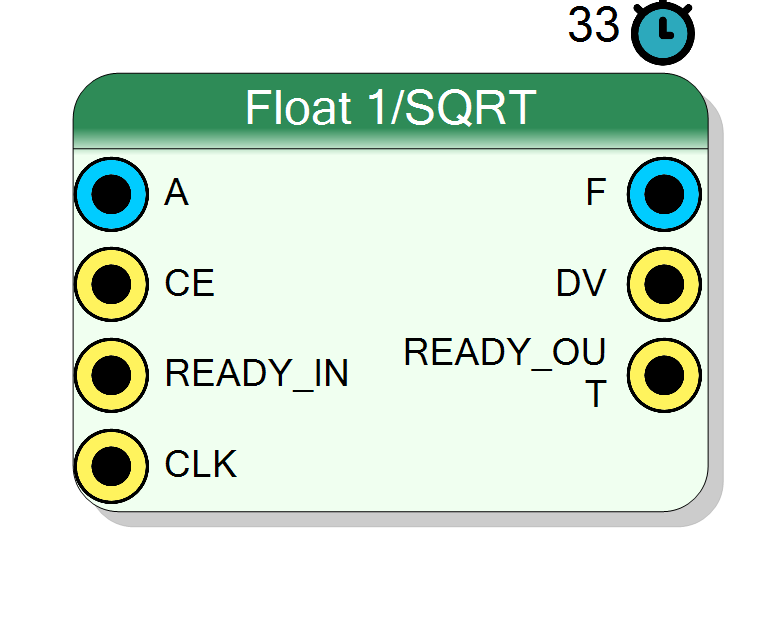
Computes the reciprocal square root (1/sqrt(x)) of IEEE-754 floating-point numbers with configurable DSP usage. Supports both single-precision (32-bit) and double-precision (64-bit) formats. Built on Xilinx Floating-Point IP core with blocking flow control and 33-cycle latency.
Introduction
The block computes the reciprocal square root of IEEE-754 floating-point inputs.
On every rising edge of CLK, if CE = 1, the reciprocal square root unit computes
$$ \mathrm{F}(n) = \frac{1}{\sqrt{\mathrm{A}(n)}}, $$
where input A and output F follow IEEE-754 single or double
precision format.
The reciprocal square root is implemented with the Xilinx floating_point IP core configured for Rec_Square_Root operation using Newton-Raphson iteration with blocking flow control, fixed 33-cycle latency, and configurable DSP primitive usage.
Pin Description
CE = 1 and READY_OUT = 1.
CE = 1, input A is accepted and reciprocal square root computation begins. Can be tied to ‘1’ for continuous operation.
DV = 1.
Result = 1/sqrt(A).
F contains a valid reciprocal square root.
Asserts 33 clock cycles after corresponding CE = 1.
Properties
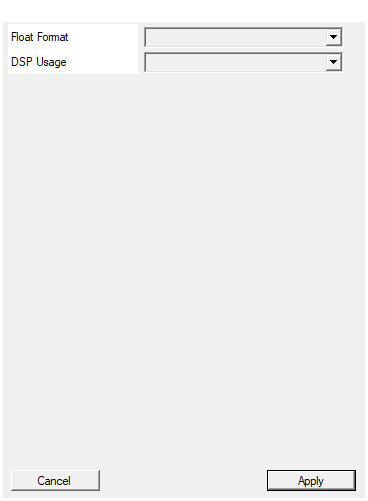
Select between single precision 32 bit and double precision 64 bit
Floating-point precision for both input and output:
- Single → 32-bit (8-bit exponent, 24-bit mantissa including implicit bit)
- Double → 64-bit (11-bit exponent, 53-bit mantissa including implicit bit)
The operation preserves the precision format end-to-end.
Default: Single
Options: Single Double
DSP Usage. Single precision: No [0], Full[9]. Double precision: No[0], Full[75]
DSP primitive allocation for Newton-Raphson iterations:
- No_Usage → LUT-only implementation (0 DSPs, lower speed)
- Full_Usage → DSP-optimized (9/75 DSPs for Single/Double, recommended, higher speed)
Full usage provides significantly better timing performance. Note: Double precision requires substantial DSP resources (75 DSP48 slices).
Default: Full_Usage
Options: No_Usage Full_Usage
Functional description
The component computes the reciprocal square root:
$$ F = \frac{1}{\sqrt{A}} $$
The implementation uses Newton-Raphson iteration specialized for reciprocal square root:
$$ x_{n+1} = \frac{x_n}{2} (3 - A \cdot x_n^2) $$
converging to $1/\sqrt{A}$. This single operation is often faster than computing
sqrt(A) followed by 1/sqrt(A).
Special cases
IEEE-754 special value handling:
1/sqrt(1) = 11/sqrt(0) = +Inf1/sqrt(x) = NaNforx < 0(domain error)1/sqrt(+Inf) = +01/sqrt(NaN) = NaN(NaN propagation)
DSP Usage
The DSP Usage property controls Newton-Raphson iteration resources:
Single precision:
- No_Usage → Pure LUT implementation (0 DSPs, lower speed)
- Full_Usage → DSP-optimized (9 DSPs, higher speed)
Double precision:
- No_Usage → Pure LUT implementation (0 DSPs, lower speed)
- Full_Usage → DSP-optimized (75 DSPs, higher speed)
Full DSP usage significantly improves timing but requires substantial DSP48 resources, especially for double precision.
Timing
The IP has a fixed 33-cycle pipeline latency:
| Clock cycle | Event |
|---|---|
| 0 | Input A presented with CE = 1 |
| 33 | Output F valid with DV = 1 |
The READY_IN/READY_OUT handshake signals enable backpressure control for streaming applications.
Typical use cases
- Vector normalization (x / ||x|| = x × (1/sqrt(x·x)))
- Fast inverse square root in graphics and physics
- Mahalanobis distance computation
- Whitening transformations in machine learning
Performance note
Computing 1/sqrt(x) directly is faster than computing 1/sqrt(x) as two
separate operations (sqrt then reciprocal). Use this block when the result
needed is the reciprocal square root itself.
For simple normalization, this is often combined with multiplication:
normalized = value × (1/sqrt(sum_of_squares))