
CORDIC Polar -> Rect
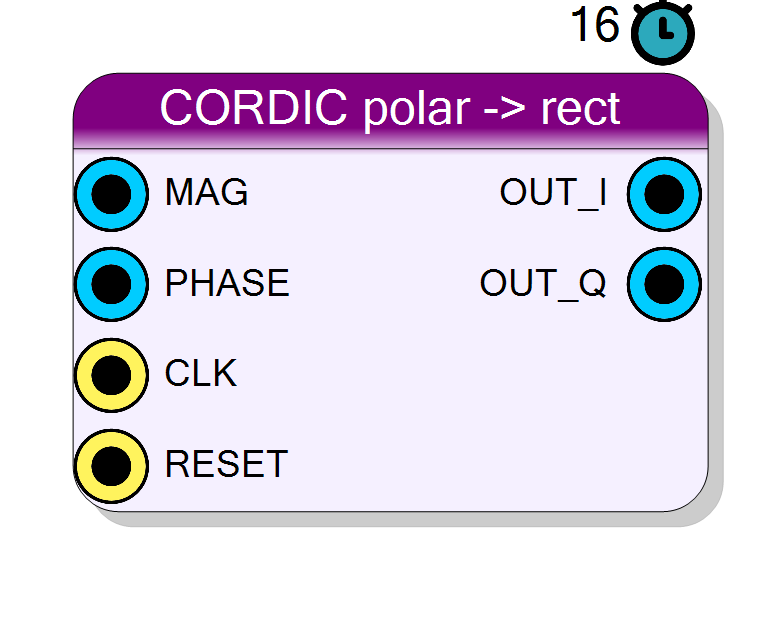
CORDIC polar-to-rectangular converter: takes a magnitude and a phase and produces the complex sample I = magcos(phase), Q = magsin(phase) using only shifts and adds. Typical use: IQ modulator, phase rotator, direct digital synthesis of an arbitrary-amplitude tone.
Introduction
The CORDIC Polar -> Rect block is the inverse of Component_ComplexAtan2. Given a magnitude and a phase it reconstructs the complex sample:
OUT_I = MAG * cos(PHASE) * K_cordic
OUT_Q = MAG * sin(PHASE) * K_cordic
It runs the CORDIC algorithm in rotation mode: starting from the
vector (x, y) = (MAG, 0) it rotates by the requested angle PHASE in
successively smaller steps atan(2^-k), driving the angle accumulator z
towards zero. Each step is a shift and an add/sub - no multipliers, no
sin/cos ROM.
The phase uses the same full-scale convention as the atan2 block, so the two are directly composable (rect -> polar -> rect).
Pin Description
+/-Pi = +/-32768. Compatible
with the PHASE output of Component_ComplexAtan2 and with the NCO phase.
~= 1.647 * MAG * cos(PHASE). Signed, OutSize bits.
~= 1.647 * MAG * sin(PHASE). Signed, OutSize
bits.
Properties
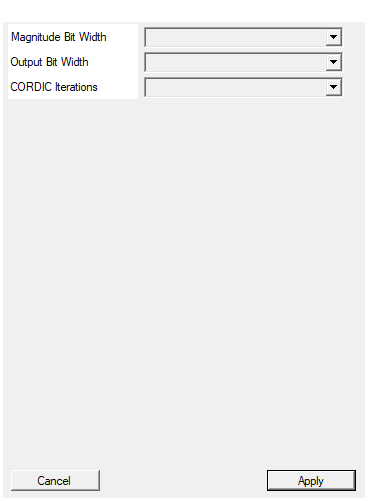
Bit width of the magnitude input (unsigned).
Bit width of the unsigned magnitude input. Range 8 to 32, default 18.Default: 18
Options: 8 9 10 11 12 13 14 15 16 17 18 19 20 21 22 23 24 25 26 27 28 29 30 31 32
Bit width of each I/Q output (signed). Includes CORDIC 1.647x gain.
Bit width of each signed I / Q output. Range 8 to 32, default 18. Choose it to accommodate the ~1.647x CORDIC gain, or pre-scale the magnitude to cancel it.Default: 18
Options: 8 9 10 11 12 13 14 15 16 17 18 19 20 21 22 23 24 25 26 27 28 29 30 31 32
Number of CORDIC iterations. 16 gives ~15-bit precision. Latency = NIter clocks.
Number of CORDIC iterations. Selectable 8, 12, 16, 20; default 16 (~15-bit precision). Latency equalsNIter clocks. Values above
16 add latency without extra angle resolution (16-bit angle LUT
exhausted past iteration 15).
Default: 16
Options: 8 12 16 20
Usage
Phase scaling
PHASE is a signed 16-bit value with +/-Pi mapped to +/-2^15:
+Pi = +32768 (wraps) +Pi/2 = +16384
0 = 0 -Pi/2 = -16384
This matches Component_ComplexAtan2 and the NCO, so a phase accumulator or an atan2 output can drive this block unchanged.
Convergence-range folding
CORDIC rotation only converges for |angle| <= ~Pi/2. For |PHASE| > Pi/2
the block first does a 180-degree pre-rotation (negate x) and shifts z
by Pi, so the iterative part always sees |z| < Pi/2:
z > +Pi/2 (=16384) : z -= Pi (32768), x = -x
z < -Pi/2 : z += Pi, x = -x
Iterations and the angle LUT
Each iteration k = 0 .. N_ITER-1 rotates by +/-atan(2^-k), taken from
the same table as the atan2 block:
ATAN_LUT[k] = round(atan(2^-k) * 32768 / Pi)
k : 0 1 2 3 4 5 6 7 8 ...
LUT: 8192 4836 2555 1297 651 326 163 81 41 ...
N_ITER angle precision latency
8 ~8 bits 8 clocks
12 ~12 bits 12 clocks
16 ~15 bits (default) 16 clocks
20 ~15 bits (LUT exhausted past k=15)
The CORDIC gain (NOT compensated)
The output carries the CORDIC processing gain K_cordic ~= 1.647:
OUT_I = 1.647 * MAG * cos(PHASE)
OUT_Q = 1.647 * MAG * sin(PHASE)
This block does not remove the gain. If you need unity gain, pre-scale
the magnitude input by 0.607 (~= 1 / 1.647) before this block. For most
uses (modulation, rotating an existing complex vector) the 1.647x is simply
absorbed into a downstream scale or AGC.
Bit widths
MAG: unsignedMagSizebits.PHASE: signed 16 bits (fixed,Pi = 32768).OUT_I,OUT_Q: signedOutSizebits. Internally the datapath usesOutSize + 2guard bits to hold the CORDIC gain before the final truncation toOutSize.
Defaults: MagSize = 18, OutSize = 18. Size OutSize so that
1.647 * MAG_full_scale fits, or pre-scale as above.
Latency and throughput
#pragma HLS PIPELINE II=1: one sample per clock.- The
N_ITERiterations are fully unrolled and pipelined: latency isN_ITERclocks (default 16), throughput one sample per clock. (The schematic symbol reports a nominal latency of 16.) - All ports use the
ap_noneinterface (no ready/valid handshake).
Reset
RESET is the HLS synchronous reset (ap_rst) and clears the pipeline
registers.
Typical applications
- IQ modulator : feed a baseband envelope on
MAGand a phase ramp onPHASEto synthesise a modulated carrier. - Phase rotator : combine with Component_ComplexAtan2 to rotate a complex stream by an arbitrary angle (rect -> polar, add angle, polar -> rect).
- Arbitrary-amplitude DDS : drive
PHASEfrom a phase accumulator andMAGfrom an amplitude profile. - Sin/cos generation : hold
MAGconstant and sweepPHASE.
Resources & Timing
-
Latency: NIter clock cycles (default 16)
-
Throughput: 1 sample per clock (II=1)
Multiplier-free: NIter fully-unrolled shift-and-add rotation stages plus a small constant angle LUT (no sin/cos ROM). Output carries an uncompensated ~1.647x CORDIC gain - pre-scale MAG by ~0.607 for unity. Phase resolution bounded by the 16-bit phase word (Pi = 32768).