
Constant Floating-Point
Generates a constant floating-point value compliant with IEEE-754 standard. Supports both single-precision (32-bit) and double-precision (64-bit) formats. Converts decimal values to standardized binary floating-point representation for FPGA designs. Zero latency, pure combinational output.
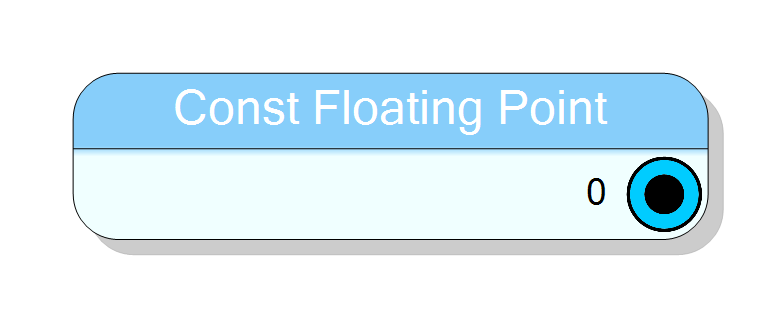
Introduction
This block generates a constant floating-point value conforming to the
IEEE-754 standard. The component converts a decimal floating-point value
(e.g., 3.14159, 6.022e23) into binary IEEE-754 representation.
Two precision modes are supported:
- IEEE-754 SINGLE: 32-bit format (1 sign + 8 exponent + 23 mantissa bits)
- IEEE-754 DOUBLE: 64-bit format (1 sign + 11 exponent + 52 mantissa bits)
The output is purely combinational with zero clock latency, suitable for direct use in floating-point arithmetic pipelines or as initialization values.
Pin Description
Constant floating-point output in IEEE-754 binary format, always combinational (zero latency). Width: 32 bits (SINGLE) or 64 bits (DOUBLE), determined by FloatingMode property.
The output is a bit-accurate representation of the specified floating-point value, ready for direct use in IEEE-754 compliant arithmetic units.
Properties
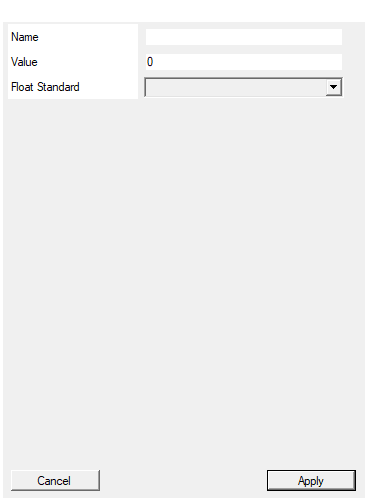
Set the value of the constant. Can be left blank
Optional custom label for the component. If specified, replaces the default title “Const Floating Point” on the schematic symbol. Leave blank to use default.Set the value of the constant.
Floating-point constant value in decimal notation. Supports standard formats: 3.14159, -2.5e-10, 6.022e23. Use comma or period as decimal separator. Automatically converted to IEEE-754 binary.Default: 0
Set floating point standard between SINGLE and DOUBLE
IEEE-754 precision standard. Choose “IEEE-754 SINGLE” for 32-bit format (~7 digit precision, range ±10^38) or “IEEE-754 DOUBLE” for 64-bit format (~15 digit precision, range ±10^308).Default: IEEE-754 SINGLE
Options: IEEE-754 SINGLE IEEE-754 DOUBLE
Functional description
The component implements an IEEE-754 floating-point constant source. Given a decimal value $V$ and precision mode, the output is:
$$ \mathrm{CONST} = \text{IEEE-754}(V, \text{mode}) $$
where the binary representation follows the IEEE-754 standard encoding.
IEEE-754 format structure
Single precision (32 bits)
| Sign (1) | Exponent (8) | Mantissa (23) |
| S | EEEEEEEE | MMMMMMMMMMMMMMMMMMMMMMM |
Value representation: $$ V = (-1)^S \times 1.M \times 2^{(E-127)} $$
- Range: $\pm 1.18 \times 10^{-38}$ to $\pm 3.40 \times 10^{38}$
- Precision: ~7 decimal digits
- Exponent bias: 127
Double precision (64 bits)
| Sign (1) | Exponent (11) | Mantissa (52) |
| S | EEEEEEEEEEE | MMMMMMMMMMMMMMMMMMMM... |
Value representation: $$ V = (-1)^S \times 1.M \times 2^{(E-1023)} $$
- Range: $\pm 2.23 \times 10^{-308}$ to $\pm 1.80 \times 10^{308}$
- Precision: ~15 decimal digits
- Exponent bias: 1023
Special values
IEEE-754 defines special bit patterns for non-finite values:
| Value | Sign | Exponent (SP) | Mantissa |
|---|---|---|---|
| +0.0 | 0 | 0x00 | 0x000000 |
| -0.0 | 1 | 0x00 | 0x000000 |
| +Infinity | 0 | 0xFF | 0x000000 |
| -Infinity | 1 | 0xFF | 0x000000 |
| NaN (quiet) | X | 0xFF | non-zero |
The component automatically handles these special cases during conversion.
Conversion example: π in single precision
Given:
- Value =
3.14159265 - Mode = IEEE-754 SINGLE
Conversion steps:
- Sign bit: 0 (positive)
- Normalize: $3.14159265 = 1.57079633 \times 2^1$
- Exponent: $1 + 127 = 128 = 0x80$
- Mantissa: $.57079633 \approx 0.10010010000111111011011$ (23 bits)
- Binary:
0 10000000 10010010000111111011011 - Hex:
0x40490FDB
Precision considerations
Single precision is suitable for:
- General-purpose floating-point arithmetic
- Graphics and signal processing (where ~7 digits is sufficient)
- Resource-constrained FPGA designs (saves 32 bits per value vs. double)
Double precision is necessary for:
- Scientific computing requiring high accuracy
- Numerical algorithms sensitive to rounding errors
- Financial calculations or precise physical constants
Rounding behavior
The conversion from decimal to binary uses the round-to-nearest-even (banker’s rounding) mode, which is the default IEEE-754 rounding mode. This minimizes cumulative rounding bias.
Implementation details
The VHDL implementation generates the IEEE-754 binary string at compile time:
vhdl
signal CONST : STD_LOGIC_VECTOR(BitSize-1 downto 0);
CONST <= "<IEEE-754 binary representation>";
The .NET BitConverter class performs the decimal-to-binary conversion,
ensuring full IEEE-754 compliance including handling of denormals, infinities,
and NaN values.
Timing
The component is purely combinational with zero latency:
| Property | Latency (clock cycles) |
|---|---|
| Constant Floating-Point | 0 |
The output is available immediately after FPGA configuration.
Typical use cases
- Mathematical constants: Define π, e, √2, or physical constants (c, G, h, etc.)
- Floating-point pipelines: Provide constant multipliers, divisors, or offsets
- DSP algorithms: Supply filter coefficients in floating-point format
- Scientific computing: Store predefined physical or mathematical values
- Calibration factors: Floating-point scaling or correction constants
- Machine learning: Neural network weights or bias values (in FP32/FP64 networks)
Example configurations
Example 1: Pi constant (single precision)
Name: "PI"
Value: 3.14159265
FloatingMode: IEEE-754 SINGLE
Output: 32 bits = 0x40490FDB
Example 2: Avogadro’s number (double precision)
Name: "Na"
Value: 6.02214076e23
FloatingMode: IEEE-754 DOUBLE
Output: 64 bits = 0x44B52D02C7E14AF6
Example 3: Small fractional constant
Value: 0.001
FloatingMode: IEEE-754 SINGLE
Output: 32 bits = 0x3A83126F
Example 4: Negative constant
Value: -273.15
FloatingMode: IEEE-754 DOUBLE
Output: 64 bits (sign bit = 1)