
Complex Magnitude Approx |A|
Fast linear magnitude estimate |A| ~= alphamax(|I|,|Q|) + betamin(|I|,|Q|) using only shifts and adds (no multiplier, no square root). Worst-case error about 2%. Typical use: cheap envelope / AGC magnitude, RSSI where a couple of percent error is acceptable.
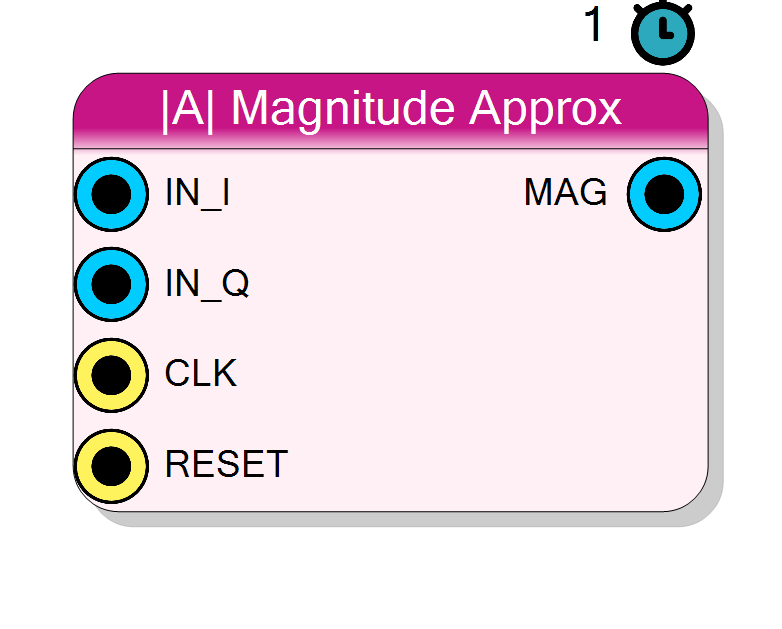
Introduction
The Complex Magnitude Approx block estimates the linear magnitude
(envelope) of the complex input A = IN_I + j*IN_Q without a square root
and without a multiplier. It uses the classic alpha-max-plus-beta-min
identity:
|A| = sqrt(I^2 + Q^2) ~= alpha * max(|I|,|Q|) + beta * min(|I|,|Q|)
The ideal min-worst-case coefficients are alpha = 0.947, beta = 0.393
(~4% peak error). To stay multiplier-free this block uses power-of-two
friendly coefficients implemented with shift-and-add:
15/16 * max = max - (max >> 4) (alpha = 0.9375)
15/32 * min = (min >> 1) - (min >> 5) (beta = 0.46875)
|A| ~= 15/16*max + 15/32*min
This choice gives about 2% worst-case error at zero DSP cost. For an
exact power figure use Component_ComplexMagSq (|A|^2); for a true
magnitude use Component_ComplexAtan2 (CORDIC).
Pin Description
|IN_I| of a real signal.
|A|. Unsigned, InputSize + 2 bits.
Properties
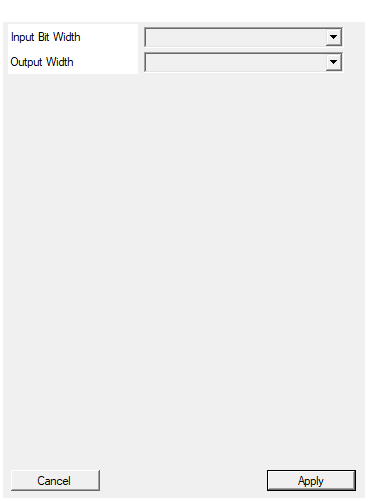
Bit width of each I/Q sample (signed).
Bit width of each signed I / Q input sample. Range 4 to 32, default 16. Output width isInputSize + 2.
Default: 16
Options: 4 5 6 7 8 9 10 11 12 13 14 15 16 17 18 19 20 21 22 23 24 25 26 27 28 29 30 31 32
Extended = InputSize+2 (headroom, matches the other complex ops). Same as input = InputSize (no growth along a chain). The magnitude max is 0.703*2^InputSize so it always fits the input width UNSIGNED - ‘Same as input’ is lossless.
Default: Extended (In+2)
Options: Extended (In+2) Same as input
Usage
Algorithm
ai = |IN_I|
aq = |IN_Q|
mx = max(ai, aq)
mn = min(ai, aq)
MAG = (mx - (mx >> 4)) + ((mn >> 1) - (mn >> 5))
Taking max/min of the absolute values restricts the vector to a 45-deg
wedge where the linear combination best approximates the Euclidean norm.
The error oscillates between roughly 0% and +2% over angle; it is a slight
over-estimate on average.
Bit widths
Inputs are signed; the internal absolute values and the output are unsigned (magnitude is non-negative).
IN_I,IN_Q: signedInputSizebits.- internal
|I|,|Q|: unsignedInputSizebits. MAG: unsignedInputSize + 2bits.
Two guard bits are added because alpha*max + beta*min can exceed the
InputSize-bit range of a single channel (the sum of the two weighted
terms is up to ~1.4x the larger input). With the default InputSize = 16
the output is 18 bits.
Accuracy vs. alternatives
block error cost
complex_mag_approx ~2% (|A|) shifts + adds, 0 DSP
complex_atan2 (mag) exact* CORDIC, adders, N_ITER clocks
complex_magsq exact (|A|^2) 2 DSP
(*atan2 magnitude carries the fixed 1.647x CORDIC gain.)
Latency and throughput
#pragma HLS PIPELINE II=1: one result per clock.- 1-clock latency.
- All ports use the
ap_noneinterface (no ready/valid handshake).
Reset
RESET is the HLS synchronous reset (ap_rst); it clears the output
register.
Typical applications
- Envelope detector for an AM signal or a modulated pulse.
- RSSI / signal-present indicator where ~2% error is fine.
- AGC magnitude feedback term (cheaper than a CORDIC).
Resources & Timing
-
Latency: 1 clock cycle
-
Throughput: 1 sample per clock (II=1)
No multiplier and no square root: two absolute-value units, a compare/select for max/min, and four shift-and-add terms. Worst-case magnitude error ~2%. Fully pipelined.