
FLOATING POINT - FLOAT TO FIXED
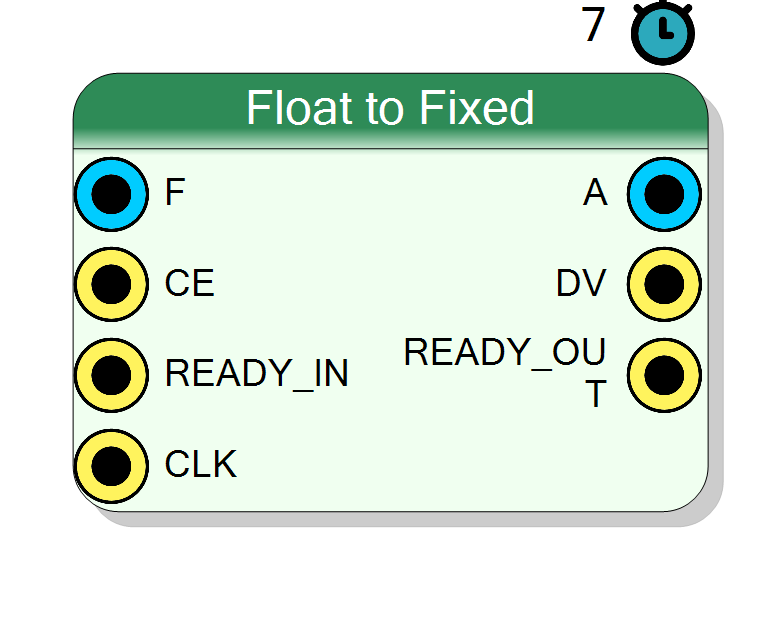
Converts IEEE-754 floating-point values to fixed-point integers. Supports both single-precision (32-bit) and double-precision (64-bit) input formats with configurable output integer and fractional bit widths. Built on Xilinx Floating-Point IP core with blocking flow control and 7-cycle latency.
Introduction
The block converts IEEE-754 floating-point values to fixed-point integer format,
enabling integration between floating-point algorithms and fixed-point hardware
implementations.
On every rising edge of CLK, if CE = 1, the converter performs
$$ \mathrm{A}(n) = \text{fixed}(\mathrm{F}(n)), $$
where the input F follows IEEE-754 single or double precision format,
and the output A is a custom fixed-point format with user-defined integer and
fractional bit widths.
The conversion is implemented with the Xilinx floating_point IP core configured for float_to_fixed operation with blocking flow control and a fixed 7-cycle latency.
Pin Description
CE = 1, input F is accepted and conversion begins. Can be tied to ‘1’ for continuous operation.
DV = 1.
A contains valid converted data.
Asserts 7 clock cycles after corresponding CE = 1.
Properties
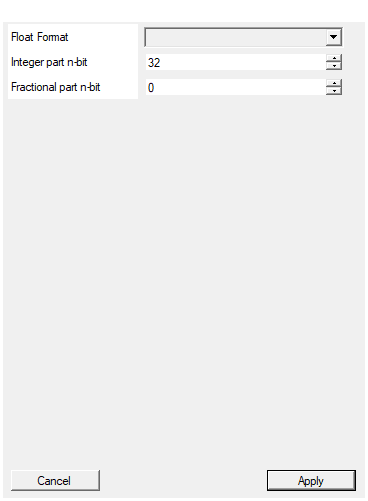
Select between single precision 32 bit and double precision 64 bit
Input floating-point precision:
- Single → 32-bit (8-bit exponent, 24-bit mantissa including implicit bit)
- Double → 64-bit (11-bit exponent, 53-bit mantissa including implicit bit)
Single precision provides ~7 decimal digits; Double provides ~16 decimal digits.
Default: Single
Options: Single Double
Number of bits in the integer part of the input
Number of bits in the integer part of the fixed-point output. Range: 0 - 64. Determines the maximum integer magnitude that can be represented. Total output width = IntLength + FractLength.Default: 32
Range: 0 – 64
Number of bits in the factional part of the input
Number of bits in the fractional part of the fixed-point output. Range: 0 - 64. Determines the precision of fractional values in the output. The output represents values with resolution $2^{-\text{FractLength}}$.Default: 0
Range: 0 – 64
Functional description
The component converts floating-point input to fixed-point output:
$$ A = \text{round}\left(F \times 2^{F_{\text{bits}}}\right), $$
where:
F→ input floating-point value (IEEE-754)A→ output fixed-point value (signed integer)- $F_{\text{bits}}$ → Fractional part n-bit property
The total output width is Integer part n-bit + Fractional part n-bit.
Overflow/Underflow: Values exceeding the representable range will saturate or wrap according to the Xilinx IP core configuration.
IEEE-754 Input Format
Accepts standard IEEE-754 encoded values:
Single precision (32-bit):
- 1 sign bit
- 8 exponent bits
- 23 mantissa bits (24 with implicit leading 1)
Double precision (64-bit):
- 1 sign bit
- 11 exponent bits
- 52 mantissa bits (53 with implicit leading 1)
Timing
The IP has a fixed 7-cycle pipeline latency:
| Clock cycle | Event |
|---|---|
| 0 | Input F presented with CE = 1 |
| 7 | Output A valid with DV = 1 |
The READY_IN/READY_OUT handshake signals enable backpressure control for streaming applications.
Typical use cases
- Converting floating-point algorithm results to fixed-point for DAC output
- Interface between floating-point processing and fixed-point control logic
- Quantization for fixed-point implementation prototyping
- Data type conversion in mixed-precision pipelines