
FFT Windowed
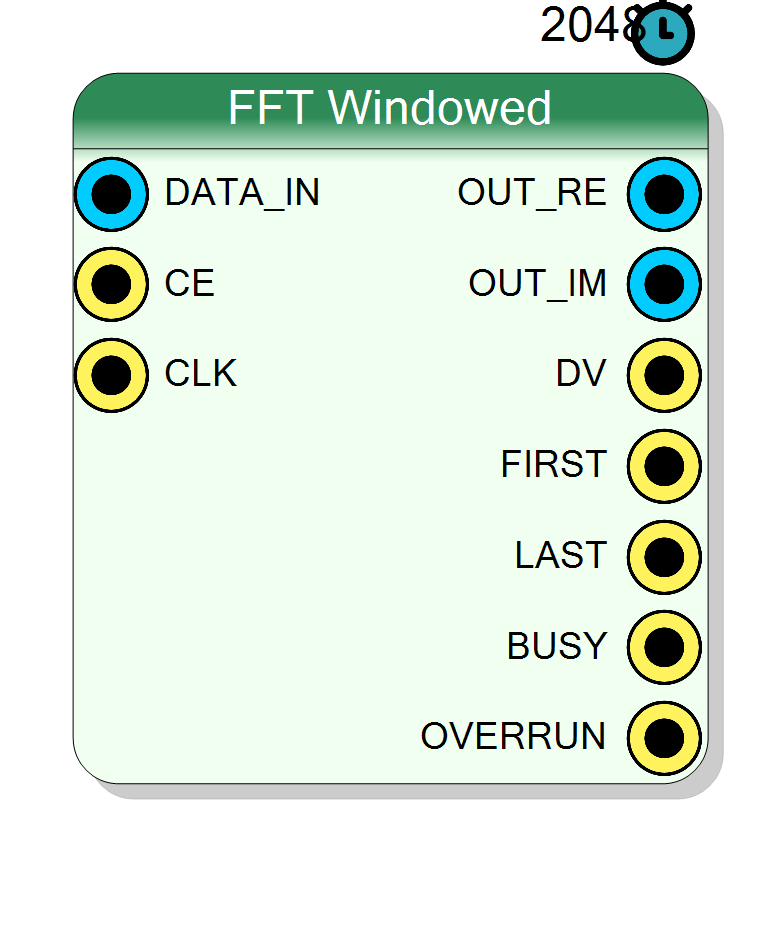
Advanced sequential FFT with windowing and frame overlap. 19 window families (Hann, Hamming, Blackman-Harris, Flat Top, Kaiser, Dolph-Chebyshev, Taylor, DPSS…) designed interactively in a WebView2 GUI with a test-tone simulator; overlap None/25%/50% with automatic dual-core ping-pong. Compile-time window ROM; see FFT Windowed Prog for the runtime-loadable variant.
Introduction
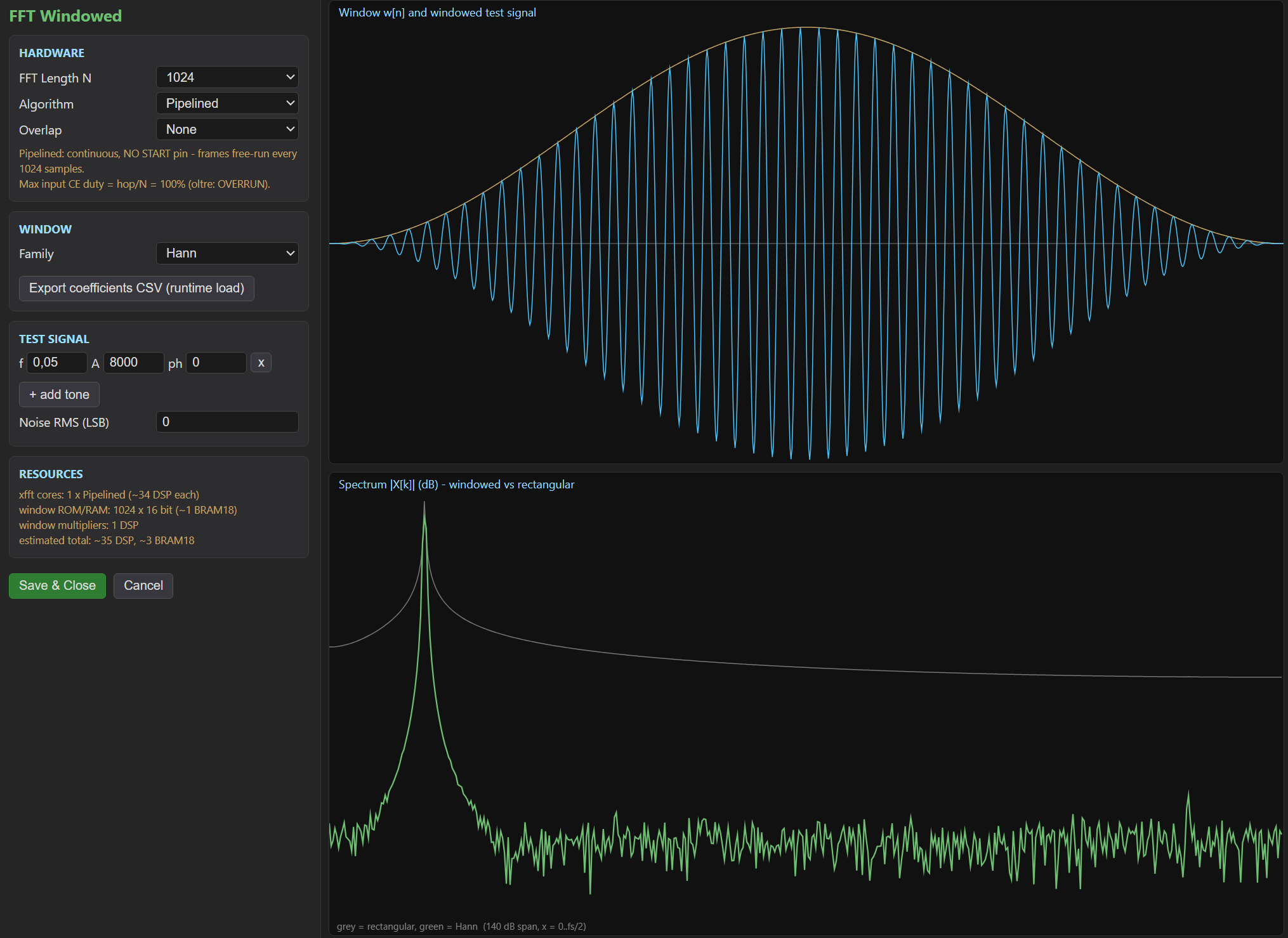
The block computes $X[k] = \sum_n w[n],x[n],e^{-j2\pi kn/N}$ : each input sample is multiplied by a 16-bit Q16 window coefficient before entering a Xilinx xfft core (unscaled, natural order). Double-clicking the block opens the FFT Windowed Designer: choose the window family (and its parameter - Kaiser $\beta$, Gaussian $\sigma$, Tukey $\alpha$, Chebyshev/Taylor sidelobe level, DPSS NW), build a test signal from tones (frequency, amplitude, PHASE each) plus noise, and see the windowed waveform and the resulting spectrum (dB) against the rectangular reference. The panel also shows the resource estimate and the timing constraints of the chosen configuration.
Pin Description
Properties
Transform length N (power of 2)
Transform length N (128..16384, power of 2).Default: 1024
Options: 128 256 512 1024 2048 4096 8192 16384
Pipelined: continuous, no START pin, frames free-run every hop samples. Radix-4/Radix-2/Radix-2 Lite: framed, needs START (tie to ‘1’ for auto restart).
Pipelined (continuous, no START) or Radix-4 / Radix-2 / Radix-2 Lite burst engines (framed, START required). Same area/speed trade-offs as the FFT block.Default: Pipelined
Options: Pipelined Radix-4 Radix-2 Radix-2 Lite
Frame overlap. None: 1 core. 25% (hop=3N/4) or 50% (hop=N/2): TWO xfft cores in ping-pong. Max input CE duty = hop/N.
None / 25% / 50%. Overlap instantiates two xfft cores automatically and limits the input CE duty to hop/N.Default: None
Options: None 25% 50%
Window family (set by the designer, double-click the block)
Window family - set from the designer (double click).Default: Hann
Designer state incl. window coefficients (Q16)
Continuous vs framed operation
- Pipelined engine: NO START pin. The block processes continuously: a new frame begins automatically every hop = N - overlap samples and spectra stream out back to back.
- Radix-4 / Radix-2 / Radix-2 Lite: the FFT is framed, not continuous - the START pin begins a frame (bin 0 = the START sample). Tie START to ‘1’ to restart automatically every hop samples. The designer reminds you of this.
Overlap
With overlap 25% (hop = 3N/4) or 50% (hop = N/2) TWO xfft cores are instantiated automatically in ping-pong: every incoming sample feeds up to two active frames with different window phases (no history buffer). Output bursts are serialized in strict frame order; a per-core elastic FIFO absorbs the backpressure. The input CE duty must not exceed hop/N (100% / 75% / 50%): a missed frame boundary raises a one-cycle OVERRUN pulse and the scheduler retries.
Verified in simulation (N=256, Hann, 50% overlap, CE duty 50%, two-tone signal): 41 consecutive overlapping frames all match the numpy windowed FFT within 6e-5, zero overruns.
Outputs
Sequential complex bins on OUT_RE / OUT_IM (32 bit, unscaled full precision = 16 + log2 N + 1 bits), DV per bin, FIRST / LAST frame markers, BUSY, OVERRUN.
Coefficient export
The designer’s Export CSV button saves the Q16 coefficients (addr,coef per line) to load at runtime into the FFT Windowed Prog variant through its COEF_ADDR / COEF_DATA / COEF_WE bus.