
TM Packer
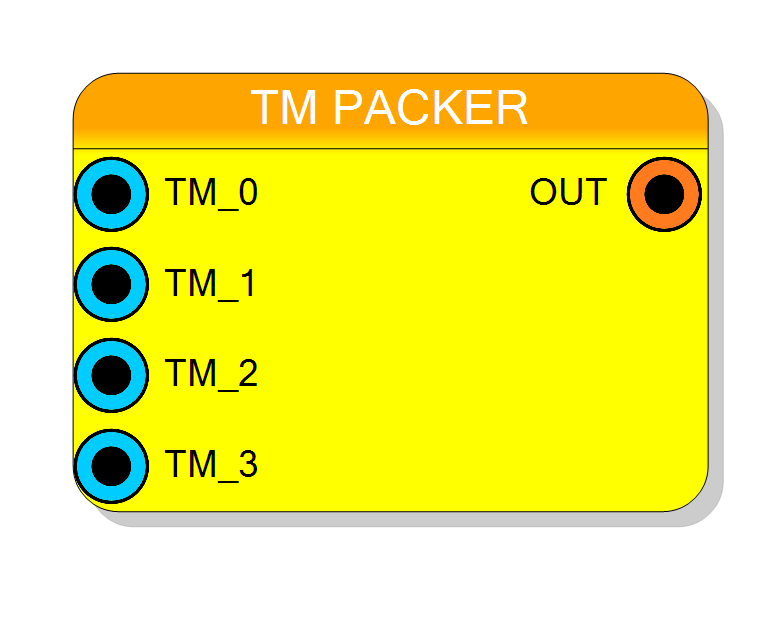
Packs multiple independent std_logic_vector signals into a single time-multiplexed (TM) bus. Takes N separate scalar inputs and concatenates them into a TM output where each input becomes one TM phase. Supports TM factors from 2 to 32. Pure combinational logic with zero latency.
Introduction
This block packs multiple independent scalar signals into a single time-multiplexed (TM) bus. It is used to combine parallel data streams into a compact TM representation for efficient processing.
The operation is purely combinational with zero clock latency:
$$ \mathrm{OUT}[W \times (i+1) - 1 : W \times i] = \mathrm{TM}_i, \quad i = 0 \ldots N-1 $$
where $W$ is the word size and $N$ is the TM factor.
Pin Description
Output TM bus, always TM. Width: Word Size × TM Factor TM Factor: Configurable (2 to 32)
Bit layout: OUT[(i+1)×W-1 : i×W] = TM_i Output is combinational (zero latency).
N independent scalar input signals (where N = TM Factor). Each input: std_logic_vector of width = Word Size Pin names: TM_0, TM_1, TM_2, …, TM_{N-1}
All inputs must be connected for successful compilation.
Properties
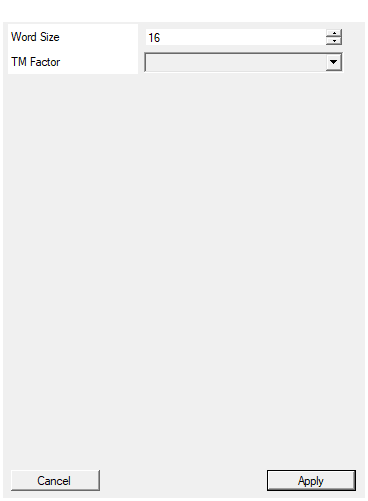
Set the size in bit of word in the input/output
Width in bits of each input signal (1 to 16384 bits). All inputs must have this same width.Default: 16
Range: 1 – 16384
Select the TM Factor of the input
Number of TM phases (2 to 32). This determines how many input pins (TM_0 through TM_{N-1}) are created. Total output width = Word Size × TM Factor.Default: 4
Options: 2 4 8 16 32
Functional description
The TM Packer concatenates N independent scalar inputs into a single TM bus. Each input signal becomes one phase of the output TM bus.
Packing operation
For a TM factor of $N$ and word size $W$:
$$ \mathrm{OUT} = \mathrm{TM}{N-1} ,||, \mathrm{TM}{N-2} ,||, \ldots ,||, \mathrm{TM}_1 ,||, \mathrm{TM}_0 $$
where $||$ denotes concatenation. In bit notation:
- Phase 0 → bits $[W - 1 : 0]$
- Phase 1 → bits $[2W - 1 : W]$
- Phase $i$ → bits $[(i+1)W - 1 : iW]$
- Phase N-1 → bits $[NW - 1 : (N-1)W]$
Total output width: $W \times N$ bits
Example with TM Factor = 4, Word Size = 16
Four 16-bit inputs packed into a 64-bit TM output:
- TM_0 = 0x1234
- TM_1 = 0x5678
- TM_2 = 0x9ABC
- TM_3 = 0xDEF0
Packed TM output (64 bits): $$ \mathrm{OUT}[63:0] = \texttt{0xDEF0_9ABC_5678_1234} $$
Bit layout:
OUT[63:48] = 0xDEF0 (TM_3)
OUT[47:32] = 0x9ABC (TM_2)
OUT[31:16] = 0x5678 (TM_1)
OUT[15:0] = 0x1234 (TM_0)
Input requirements
- All input signals must have the same width (Word Size property)
- Number of inputs equals the TM Factor property
- All inputs must be connected for successful compilation
Signal naming
The component creates N input pins named:
- TM_0, TM_1, TM_2, …, TM_{N-1}
Each input pin is a scalar std_logic_vector of width $W$.
Timing
The component is purely combinational with zero latency:
| Property | Latency (clock cycles) |
|---|---|
| TM Packer | 0 |
The TM output is available immediately in the same clock cycle as the inputs.
Typical use cases
- Combining multiple ADC channels into a TM data stream
- Creating TM buses for parallel processing pipelines
- Interfacing scalar outputs to TM processing blocks
- Data stream multiplexing for bandwidth optimization
Important notes
- All inputs must be connected - compilation will fail if any TM_i input is unconnected
- Input order matters: TM_0 becomes LSBs, TM_{N-1} becomes MSBs
- No clock required - purely combinational wiring
- Inverse operation: use TM Splitter to unpack