
FLOATING POINT - ABSOLUTE VALUE
Computes the absolute value of IEEE-754 floating-point numbers. Supports both single-precision (32-bit) and double-precision (64-bit) formats. Built on Xilinx Floating-Point IP core with zero-latency combinatorial operation.
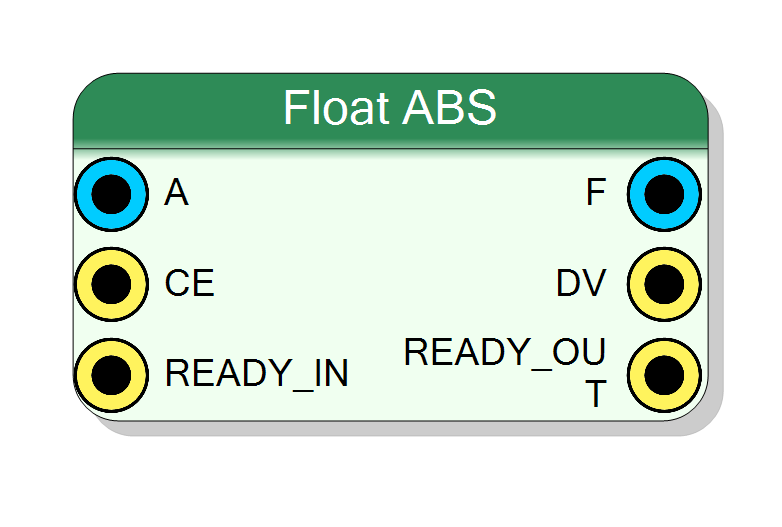
Introduction
The block computes the absolute value of floating-point inputs, effectively
clearing the sign bit of IEEE-754 encoded values.
On every clock cycle with CE = 1, the operation performs
$$ \mathrm{F}(n) = |\mathrm{A}(n)|, $$
where both input A and output F follow IEEE-754 single or double
precision format.
The operation is implemented with the Xilinx floating_point IP core configured for Absolute operation with zero latency (purely combinatorial).
Pin Description
CE = 1, input A is processed and output F is valid. Can be tied to ‘1’ for continuous operation.
DV = 1 (same cycle as CE = 1).
CE for zero-latency operation.
Indicates when output F contains valid data.
Properties
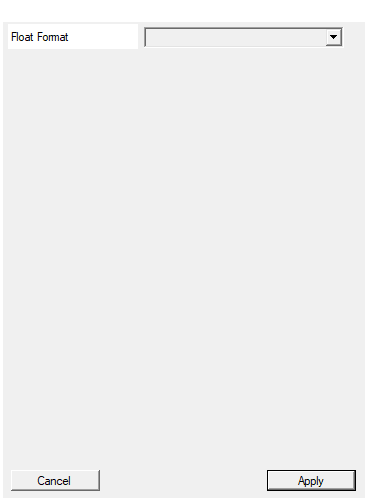
Select between single precision 32 bit and double precision 64 bit
Floating-point precision for both input and output:
- Single → 32-bit (8-bit exponent, 24-bit mantissa including implicit bit)
- Double → 64-bit (11-bit exponent, 53-bit mantissa including implicit bit)
The operation preserves the precision format end-to-end.
Default: Single
Options: Single Double
Functional description
The component computes the absolute value:
$$ F = |A| = \begin{cases} A & \text{if } A \geq 0 \ -A & \text{if } A < 0 \end{cases} $$
In hardware, this is efficiently implemented by clearing the sign bit (MSB) of the IEEE-754 representation.
Special cases
The absolute value operation handles IEEE-754 special values:
|+0| = +0|-0| = +0|+Inf| = +Inf|-Inf| = +Inf|NaN| = NaN(sign bit cleared, preserving payload)
Timing
Zero-latency operation:
| Clock cycle | Event |
|---|---|
| 0 | Input A presented with CE = 1 |
| 0 | Output F valid immediately (same cycle) |
Since the operation is combinatorial, DV follows CE without delay.
Typical use cases
- Magnitude computation in complex signal processing
- Distance metrics (L1 norm components)
- Envelope detection in RF/audio processing
- Error magnitude computation in control systems