
Variable Delay Fine [TM]
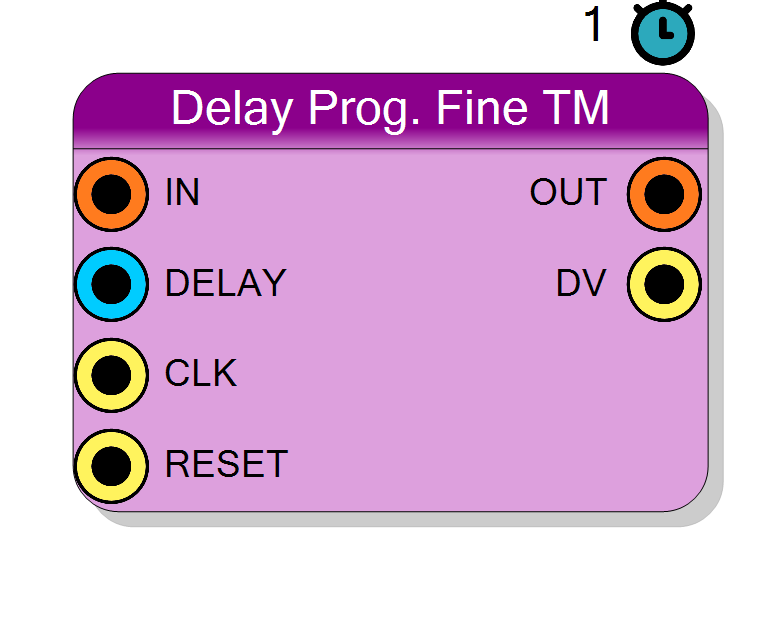
Advanced time-multiplexed programmable delay with sample-level precision. Unlike group TM delay, this variant can delay individual TM samples (not just groups), providing fine-grained control. Uses HLS-generated IP core for Xilinx FPGAs. Includes data-valid (DV) output signal.
Introduction
This block implements a fine-grained programmable TM delay where the DELAY input specifies delays in individual samples, not TM groups. This allows sub-group timing precision for advanced applications.
Note: Max Delay Value is specified in samples (not TM groups), allowing fractional-group delays.
Pin Description
Properties
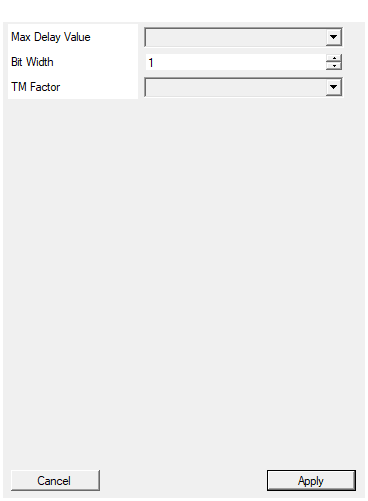
Set the amount of memory to reserve for this delay line (in samples, not TM groups)
Maximum delay in samples (not groups). Range: 256-131072. Memory allocated = ceiling(MaxDelayValue / TMFactor) + 1 TM groups.Default: 4096
Options: 256 512 1024 2048 4096 8192 16384 32768 65536 131072
Set the size in bits of the signal to be delayed
Bit width per TM phase. Range: 1-1024.Default: 1
Range: 1 – 1024
Time Multiplexing factor
TM Factor. Allowed: 4, 8, 16, 32.Default: 4
Options: 4 8 16 32
Functional description
Unlike the standard Variable Delay TM which delays entire TM groups, this variant:
- Delays at sample resolution (DELAY counts individual samples, not groups)
- Requires Xilinx FPGA (uses Vivado HLS)
- Generates custom IP core at compile time
- Provides DV (data valid) output signal
Implementation
Uses Vivado HLS to generate optimized delay logic. The component is synthesized from C++ source code (see Resources/CODE_delay_fine_tm) during project compilation.
Max Delay in samples
If TM Factor = 4 and Max Delay = 4096:
- You can delay by 4096 samples total
- This equals 1024 TM groups (4096 / 4)
- Fine control: DELAY can be any value 0-4095
Timing
Latency = 1 clock cycle (inherent to HLS pipeline).
Typical use cases
- High-precision timing applications
- Fractional-group delay requirements
- Applications needing data-valid signaling
Design considerations
Xilinx-only: Requires Vivado HLS toolchain. Not supported on Intel FPGAs.