
Trigger Derivative TM
Time-multiplexed derivative-based digital trigger with programmable word width, decorrelation delay and selectable polarity. Generates a single-cycle trigger pulse when the derivative of the input signal exceeds a programmable threshold, with optional dead-time inhibition between successive triggers.
Introduction
The Trigger Derivative TM core implements a derivative-based discriminator designed for time-multiplexed (TM) data streams, commonly used in high-speed nuclear and particle physics data-acquisition systems. The core processes TM_Factor parallel samples per clock cycle, computing the discrete derivative for each channel and triggering when the derivative crosses the user-defined threshold. This approach is particularly effective for detecting fast signal edges in noisy environments, where leading-edge triggers may produce false positives on slowly varying baselines.
Pin Description
V_{thr} with bit-width equal to WordSize.
The derivative is compared against this threshold; a trigger occurs when derivative >= threshold.
TRIGGER pulse (dead-time).
Set to 0 for no inhibition.
Selects derivative polarity.
1– detect positive derivatives (rising edges):derivative = x[n] - x[n-d]0– detect negative derivatives (falling edges):derivative = x[n-d] - x[n]Width = 1 bit.
CE=1; otherwise the internal state is frozen and outputs keep their last value except TRIGGER, which is forced low.
CLK.
Properties
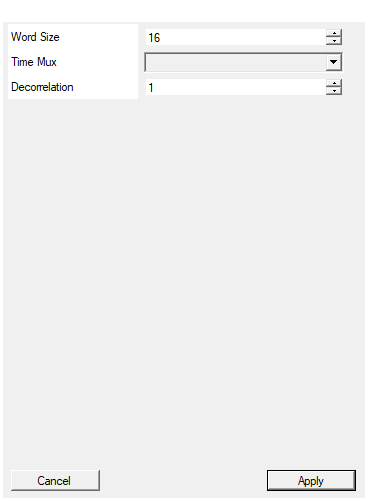
Set the number of bits of the data bus
Bit-width of each sample within the TM frame. Applies toDATA_IN, THRESHOLD, DATA_OUT and DERIVATE signals.
Acceptable range: 2 … 64, default 16.
Default: 16
Range: 2 – 64
Set number of samples for each clock cycle
Number of parallel samples processed per clock cycle (TM_Factor). Determines the effective sampling rate multiplication. Available values: 2, 4, 8, 16, 32, default 4.Default: 4
Options: 2 4 8 16 32
Set the derivative decorrelation d coefficient in the expression y = x[n] - x[n-d]
Default: 1
Range: 0 – 256
x[n] - x[n-d] (or inverted for negative polarity).
A value of 1 computes the standard first difference; larger values skip intermediate samples, providing noise rejection at the cost of reduced timing precision.
Acceptable range: 0 … 256, default 1.
Usage
Functional overview
Let
x[n]be the digitised input sample at time slot n within the TM framed– Decorrelation delay (noise_filter parameter)V_{thr}– thresholdp– polarity bit (1= positive derivative,0= negative derivative)
Derivative computation
For each of the TM_Factor parallel channels, the core computes a decorrelated derivative:
$$ \Delta x[n] ;=; \begin{cases} x[n] - x[n-d] & \text{if } p=1 \ x[n-d] - x[n] & \text{if } p=0 \end{cases} $$
where d is the decorrelation delay set by the Decorrelation property. A larger d value provides better noise immunity by comparing samples that are further apart in time.
Trigger decision
$$ \text{TRIGGER}[n] ;=; \begin{cases} 1 & \text{if } \Delta x[n] \ge V_{thr} \land \text{not inhibited} \ 0 & \text{otherwise} \end{cases} $$
The trigger is generated on the first TM channel (in time order) that satisfies the condition within each clock cycle. After each trigger, new triggers are inhibited for INHIBIT clock cycles.
Time-multiplexed outputs
The core provides multiple trigger-related outputs:
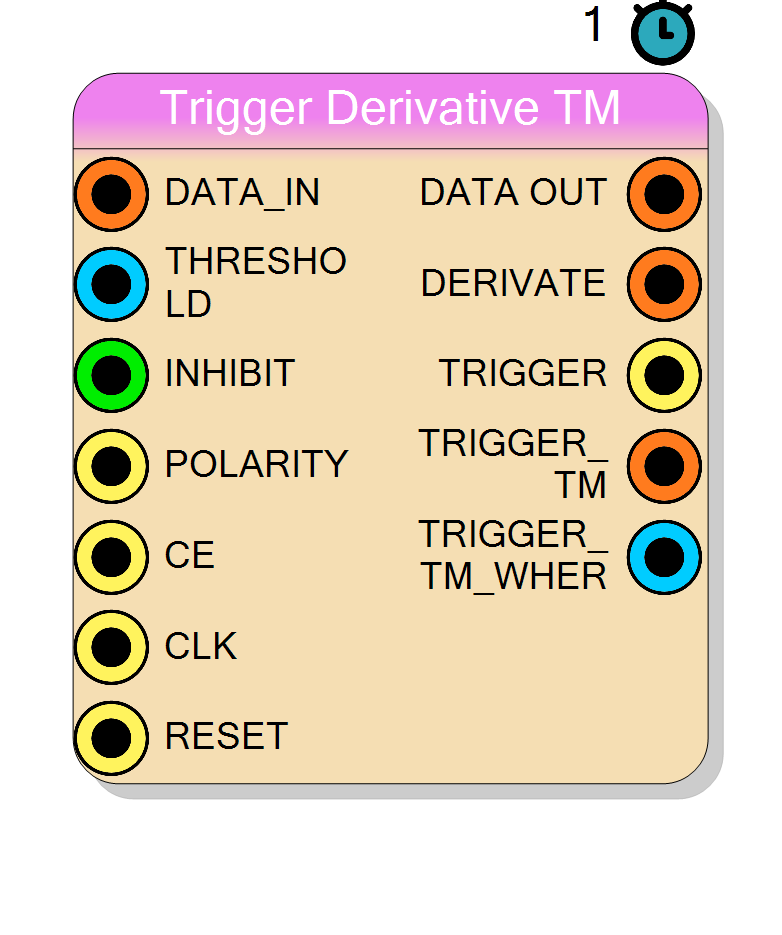
TRIGGER– single-bit pulse, asserted for one clock cycle when any TM channel triggersTRIGGER_TM– TM_Factor-bit vector indicating which specific TM channel(s) triggeredTRIGGER_TM_WHERE– binary-encoded index of the first triggering TM channel
Timing
- The derivative is computed with a latency of 1 clock cycle from the input.
TRIGGERandTRIGGER_TMare issued synchronously with the derivative computation.DATA_OUTprovides a pass-through of the input data (no additional delay).DERIVATEoutput is available with 1 clock cycle latency.
Typical applications
- Fast pulse detection in scintillator/SiPM readout systems
- Constant-fraction discriminator pre-stage
- Edge detection in high-speed digitizer applications
- Zero-crossing detection with noise rejection