
Random Generator (Arbitrary Distribution, Programmable)
Same inverse-transform-sampling engine as the fixed Random Generator, but the cumulative table is written from a bus at run time, so the distribution can be replaced without rebuilding the bitstream.
Introduction
The Programmable Random Generator draws random values from an arbitrary
distribution using inverse transform sampling, exactly like the fixed
dist_gen block: a uniform u is drawn and a binary search over the
cumulative histogram returns the bin u falls into.
The difference is where the table lives. Here it is a RAM written through
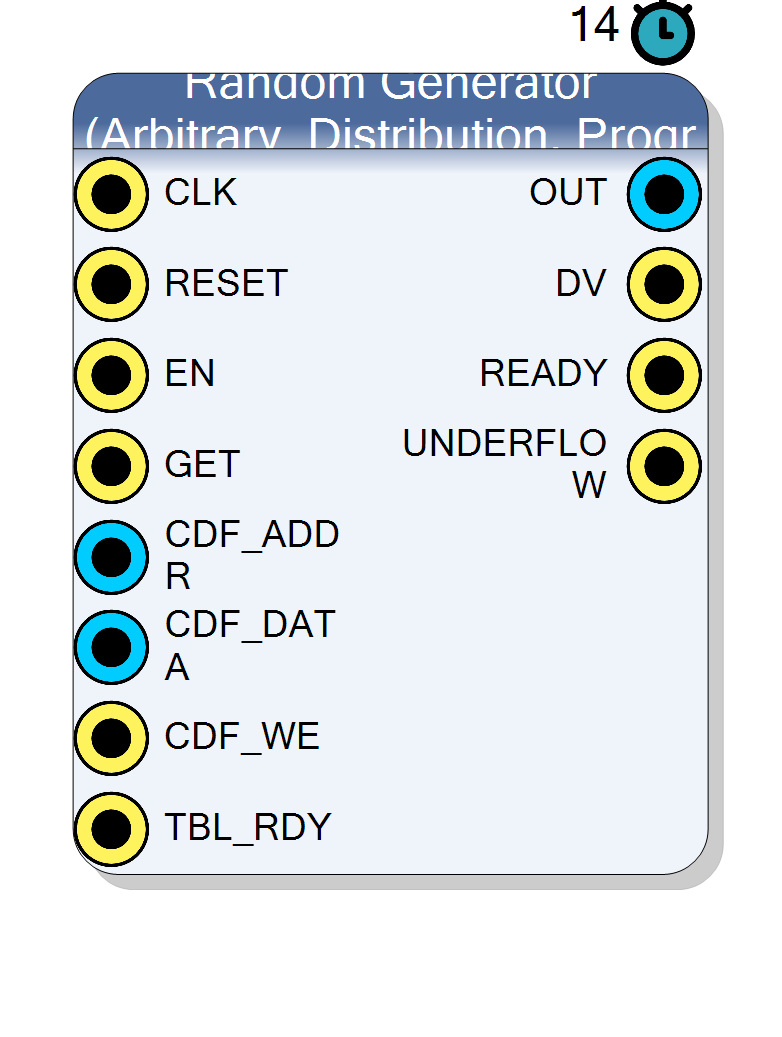
CDF_ADDR / CDF_DATA / CDF_WE, so software can load a new distribution
whenever it likes – per measurement, per channel, or from a spectrum just
acquired. There is no designer: the table is whatever you write.
Pin Description
log2(Bins) bits.
CdfWidth bits.
Properties
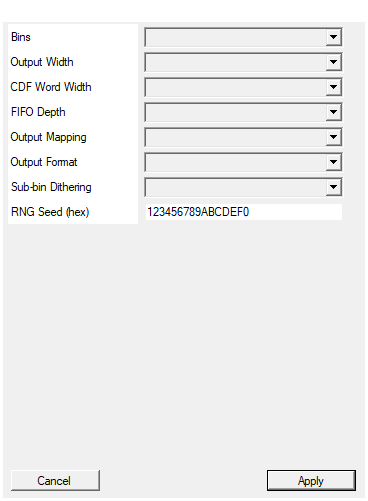
Number of CDF entries. Sets the CDF_ADDR width and the search length (log2(bins)+2 clocks per sample).
Number of entries in the cumulative table: 256, 512, 1024, 2048, 4096, 8192 or 16384, default 4096. Sets theCDF_ADDR width and the
sampling rate (log2(Bins) + 2 clocks per sample).
Default: 4096
Options: 256 512 1024 2048 4096 8192 16384
Width of the OUT port. Must be at least log2(Bins); the bits below the bin index carry the sub-bin dither.
Width of theOUT port, 8 to 32, default 16. Must be at least
log2(Bins) or the bin index would not fit; this is checked when the
property window is confirmed.
Default: 16
Options: 8 9 10 11 12 13 14 15 16 17 18 19 20 21 22 23 24 25 26 27 28 29 30 31 32
Width of one CDF entry and of the CDF_DATA bus. The table must end at 2^CdfWidth-1.
Width of one table entry and of theCDF_DATA bus: 16, 24 or 32,
default 32. The table must end at 2^CdfWidth - 1. Wider means
finer probability resolution and more BRAM.
Default: 32
Options: 16 24 32
Depth of the output first-word-fall-through queue. The generator stalls while it is full.
Depth of the output queue, 16 to 4096, default 64. The generator stalls while it is full.Default: 64
Options: 16 32 64 128 256 512 1024 2048 4096
BIN INDEX: OUT is the bin number itself, 0..Bins-1 (1024 bins on a 16-bit port give 0..1023). RESCALED: the index is stretched over the whole output width, 0..2^OutputWidth-1, with the spare low bits filled by the sub-bin dither.
How the bin index becomes the value on OUT:
- BIN INDEX –
OUTis the bin number itself,0..Bins-1. The port can be wider than the numbers it carries (1024 bins on 16 bits give0..1023). - RESCALED – the index is stretched over the whole output width,
OUT = index x 2^(OutputWidth-log2(Bins)) + dither, so 1024 bins on 16 bits give0..65535in steps of 64.
Default: RESCALED
Options: BIN INDEX RESCALED
UNSIGNED: 0..Bins-1 (bin index) or 0..2^OutputWidth-1 (rescaled). SIGNED: the same span shifted to sit on zero, two’s complement – -Bins/2..Bins/2-1 (bin index) or -2^(OutputWidth-1)..2^(OutputWidth-1)-1 (rescaled).
How the span is interpreted:
- UNSIGNED –
0..Bins-1or0..2^OutputWidth-1. - SIGNED – the same span shifted onto zero, two’s complement:
-Bins/2..Bins/2-1or-2^(OutputWidth-1)..2^(OutputWidth-1)-1.
Default: UNSIGNED
Options: UNSIGNED SIGNED
Fill the OutputWidth-log2(Bins) bits below the bin index with random bits. A histogram means constant density inside a bin, so this is the correct reconstruction; without it the output is a comb of discrete codes.
Only meaningful with OutputMapping = RESCALED, which is the only case
with bits below the index; ignored for BIN INDEX.
- YES – fill the
OutputWidth - log2(Bins)bits below the bin index with random bits. A histogram means constant density inside a bin, so this is the correct reconstruction. - NO – those bits are zero and the output is a comb of
Binsdiscrete codes with gaps between them.
Default: YES
Options: YES NO
Initial state of the xorshift64 generator, 16 hex digits. Must not be zero (a zero state locks the generator up); zero is replaced automatically. Two blocks with the same seed produce the same stream.
Initial state of the 64-bit xorshift generator, 16 hex digits, default 123456789ABCDEF0. Must not be zero (a zero state locks a xorshift generator up); zero is replaced automatically. Two blocks with the same seed produce the same stream – give independent channels different seeds.Default: 123456789ABCDEF0
Usage
What software must write
The already cumulated and normalised table, not the raw histogram. Nothing in the hardware cumulates, clears or normalises anything:
cdf(i) = round( cumsum(hist)(i) / cumsum(hist)(NBINS-1)
* (2^CdfWidth - 1) )
so that cdf is non-decreasing and cdf(Bins-1) = 2^CdfWidth - 1.
All Bins entries must be written; entries never written keep whatever the
RAM powered up with.
Bin i is selected when cdf(i-1) <= u < cdf(i), with cdf(-1) taken as
zero. Bins whose cdf equals the previous entry have zero probability and
are never produced – that is how a histogram with empty channels is
represented.
Loading sequence
1. hold TBL_RDY low -> the engine stays idle, DV low
2. write all Bins entries: drive CDF_ADDR / CDF_DATA, pulse CDF_WE
(one word per clock, any order)
3. raise TBL_RDY -> the engine starts filling the queue
Lowering TBL_RDY again stops the engine, so a table can be swapped live.
Samples already queued are not flushed; pulse RESET as well if the old
distribution must not appear at all.
TBL_RDY defaults to '0' when the pin is left unconnected, so an
unconfigured block stays quiet instead of streaming values from an
all-zero (invalid) table.
Output value, rate and queue
Identical to the fixed variant:
OUTfollows OutputMapping and OutputFormat.BIN INDEXputs the bin number itself on the port (0..Bins-1, so 1024 bins on a 16-bit port give0..1023);RESCALEDstretches it over the whole width (0..2^OutputWidth-1) with the spare low bits filled by SubBinDithering.SIGNEDshifts either span onto zero, so the four combinations give0..1023,-512..511,0..65535or-32768..32767.- one sample every
log2(Bins) + 2clocks – the cost of the binary search. - request / strobe queue:
GETat clock N delivers the sample onOUTat clock N+1 together with a one-clockDVstrobe.READYsays whether aGETwill succeed,UNDERFLOWpulses one clock after aGETon an empty queue (andDVdoes not strobe), and the generator stalls while the queue is full.
Choosing the CDF width
CdfWidth is the resolution of the probabilities, not of the values. A bin
whose probability is smaller than 1 / 2^CdfWidth rounds away to zero and
is never produced. With 16384 bins and a spectrum spanning four decades,
16 bits is not enough – use 32.
Typical applications
- Replaying a spectrum measured moments earlier, without recompiling.
- Per-channel distributions in a multi-channel emulator.
- Sweeping a parameter (peak position, resolution, background level) from software during a firmware test campaign.
Resources & Timing
-
Latency: log2(Bins) + 2 clock cycles per sample (14 with the default 4096 bins)
-
Throughput: one sample every log2(Bins) + 2 clocks; the FIFO decouples the reader
No DSP and no multiplier. The table costs ceil(CdfWidth/36) x ceil(Bins/1024) BRAM36 plus the output FIFO. Pure VHDL, no HLS. Shares the engine (dist_gen_core) with the fixed-distribution block; the random source is a 64-bit xorshift generator and the output queue is a Xilinx XPM FIFO in standard read mode (one clock of read latency), which is what gives the GET-then-strobe protocol.