
Constant Fixed-Point
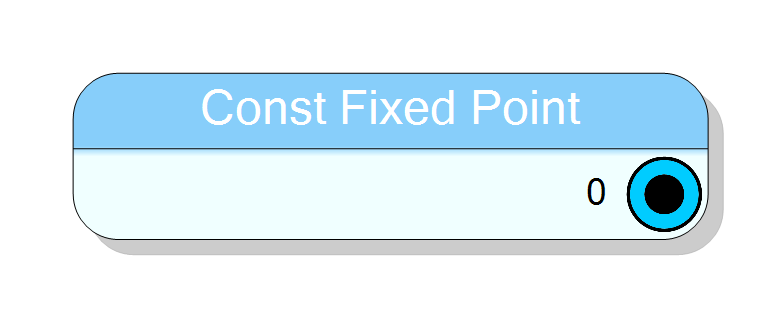
Generates a constant fixed-point value with configurable integer and fractional bit widths. Converts floating-point values to fixed-point representation for FPGA arithmetic. Supports Q-format notation with independent control of integer and decimal bits. Zero latency.
Introduction
This block generates a constant fixed-point value for use in fixed-point arithmetic pipelines. Fixed-point representation stores fractional numbers as integers with an implicit binary point position.
The user specifies a floating-point value (e.g., 3.14159), and the component
automatically converts it to fixed-point format based on the configured bit widths:
- FixedBits: Integer part width (including sign bit)
- DecimalBits: Fractional part width
Total bit width = FixedBits + DecimalBits
The output is purely combinational with zero clock latency, suitable for direct connection to fixed-point arithmetic blocks.
Pin Description
Constant fixed-point output, always combinational (zero latency).
Width: FixedBits + DecimalBits (configurable from 2 to ~2 billion bits).
The output represents a signed fixed-point number in Q-format, where the binary point is located between bit (DecimalBits-1) and bit DecimalBits.
Properties
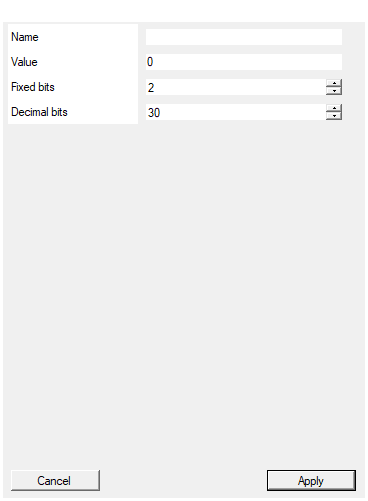
Set the value of the constant.
Optional custom label for the component. If specified, replaces the default title “Const Fixed Point” on the schematic symbol. Leave blank to use default.Set the value of the constant.
Floating-point constant value to convert to fixed-point format. Supports standard decimal notation (e.g., 3.14159, -2.5, 0.001). Use comma or period as decimal separator.Default: 0
Set the number of bits for the integer part of the number (including sign)
Number of bits for the integer part, including the sign bit. Minimum: 1 (sign only). Determines the representable range: [-2^(FixedBits-1), 2^(FixedBits-1) - 2^(-DecimalBits)].Default: 2
Set the number of bits for the decimal part of the number
Number of bits for the fractional part. Determines precision/resolution: 2^(-DecimalBits). Higher values provide better fractional accuracy but require more bits. Typical range: 8 to 32.Default: 30
Functional description
The component implements a fixed-point constant source using Q-format notation. Given a floating-point value $V$ and bit allocations, the output is:
$$ \mathrm{CONST} = \lfloor V \times 2^{D} \rceil $$
where:
- $V$ = user-specified floating-point value
- $D$ = DecimalBits (fractional precision)
- $\lfloor \cdot \rceil$ = rounding to nearest integer
The result is a $(F+D)$-bit signed integer, where $F$ = FixedBits.
Q-format notation
Fixed-point numbers use Q-format: Q(F-1).D, where:
- $F-1$ = number of integer bits (excluding sign)
- $D$ = number of fractional bits
For example, Q1.30 has:
- 1 sign bit + 1 integer bit = 2 FixedBits
- 30 DecimalBits
- Total: 32 bits
- Range: $[-2, 2 - 2^{-30}]$
- Resolution: $2^{-30} \approx 9.31 \times 10^{-10}$
Value conversion example
Given:
- Value =
3.14159 - FixedBits = 4 (1 sign + 3 integer bits)
- DecimalBits = 12 (fractional precision)
Conversion:
- Scale by $2^{12}$: $3.14159 \times 4096 = 12867.5$
- Round: $\lfloor 12867.5 \rceil = 12868$
- Binary representation (16 bits):
0011001001000100 - Interpretation: $12868 / 4096 = 3.141601…$
Range and overflow
The representable range depends on FixedBits ($F$):
$$ \text{Range} = \left[-2^{F-1}, 2^{F-1} - 2^{-D}\right] $$
For Q1.30 (F=2, D=30):
- Minimum: $-2^{1} = -2.0$
- Maximum: $2^{1} - 2^{-30} \approx 1.9999999991$
Values outside this range will overflow. The VHDL compiler will truncate overflowed values during synthesis.
Precision and resolution
Fractional resolution is determined by DecimalBits ($D$):
$$ \text{Resolution} = 2^{-D} $$
Common configurations:
| DecimalBits | Resolution | Decimal Places |
|---|---|---|
| 8 | $2^{-8} = 0.0039$ | ~2-3 digits |
| 16 | $2^{-16} = 0.000015$ | ~5 digits |
| 24 | $2^{-24} = 0.000000060$ | ~7 digits |
| 32 | $2^{-32} = 0.00000000023$ | ~10 digits |
Implementation details
The VHDL implementation converts the floating-point value to fixed-point:
vhdl
signal CONST : STD_LOGIC_VECTOR(TotalBits-1 downto 0);
CONST <= conv_std_logic_vector(round(Value * 2^DecimalBits), TotalBits);
The conversion happens at compile time, so there is no runtime overhead.
Timing
The component is purely combinational with zero latency:
| Property | Latency (clock cycles) |
|---|---|
| Constant Fixed-Point | 0 |
The output is available immediately after FPGA configuration.
Typical use cases
- Fixed-point arithmetic: Provide constant coefficients for filters, gains, or scaling factors
- Mathematical constants: Define π, e, √2, or other irrational numbers with controlled precision
- DSP pipelines: Supply fixed-point multipliers, offsets, or thresholds
- Calibration values: Store sensor calibration constants in fixed-point format
- Lookup table values: Precomputed sine/cosine tables or nonlinear function approximations
- Control systems: PID controller gains (Kp, Ki, Kd) in fixed-point representation
Example configurations
Example 1: Pi constant (Q3.28)
Name: "PI"
Value: 3.14159265
FixedBits: 4 (1 sign + 3 integer bits)
DecimalBits: 28
Total: 32 bits
Output: Scaled value representing π
Example 2: Gain factor 0.5 (Q0.15)
Value: 0.5
FixedBits: 1 (sign only)
DecimalBits: 15
Total: 16 bits
Output: Exactly 0.5 in Q0.15 format
Example 3: Negative offset (Q7.24)
Value: -12.345
FixedBits: 8 (1 sign + 7 integer bits)
DecimalBits: 24
Total: 32 bits
Output: -12.345 in fixed-point