
Float EXP TM
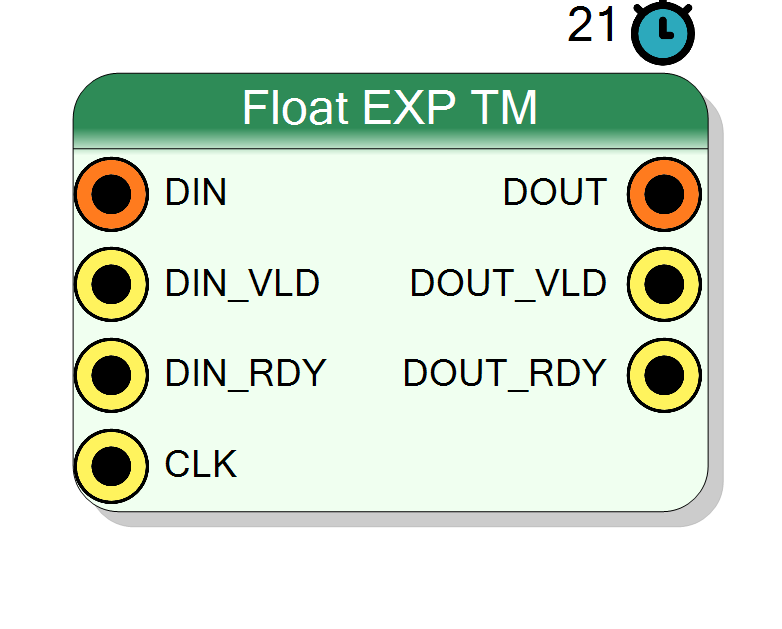
Time-multiplexed exponential function operator for IEEE 754 floating-point numbers based on Xilinx Floating Point IP. Supports single (32-bit) and double (64-bit) precision, configurable DSP and RAM usage, and multiple TM phases (1-32) for high-throughput parallel computation in scientific and signal processing applications.
Introduction
This block computes the exponential function (e^x) of IEEE 754 floating-point values using the Xilinx Floating Point IP core. The component supports Time Multiplexing (TM): multiple parallel computation units (phases) share the same clock cycle.
On every rising edge of CLK, if DIN_VLD = 1 and DOUT_RDY = 1:
$$ \mathrm{DOUT}(n) = e^{\mathrm{DIN}(n)} = \exp\bigl(\mathrm{DIN}(n)\bigr) $$
Pin Description
Properties
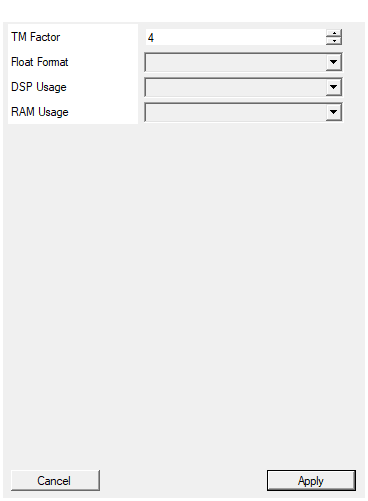
Time Multiplexing factor (number of phases)
Number of TM phases (1 – 32).Default: 4
Range: 1 – 32
Select between single precision 32 bit and double precision 64 bit
Single or Double precision.Default: Single
Options: Single Double
DSP Usage. Single precision: No [0], Medium [1], Full[2], Max[7]. Double precision: No[0], Medium [15], Full[26]
No_Usage,Medium_Usage,Full_UsageSingle: 0/1/2 DSPs; Double: 0/15/26 DSPs
Default: Full_Usage
Options: No_Usage Medium_Usage Full_Usage
Use LUT or BRAM in FPGA
No_Usage→ Use LUTsFull_Usage→ Use BRAM lookup tables
Default: Full_Usage
Options: No_Usage Full_Usage
Functional description
Wraps Xilinx Floating Point IP (operation type: Exponential) with N parallel
instances for TM support.
Input and Output
- Input
DINis always TM - Output
DOUTis always TM, same width
Mathematical background
The exponential function:
$$ y = e^x = \exp(x) $$
Properties:
- $e^0 = 1$
- $e^1 = e \approx 2.71828$
- $e^{x+y} = e^x \cdot e^y$
- $\frac{d}{dx}e^x = e^x$
Timing
Fixed latency of 21 clock cycles per phase.
| Property | Latency (cycles) |
|---|---|
| Exponential | 21 |
DSP and RAM Usage
- DSP Usage: Single: No [0], Medium [1], Full[2]; Double: No[0], Medium [15], Full[26]
- RAM Usage: No_Usage or Full_Usage (uses BRAM for lookup tables)
Typical use cases
- Gaussian function computation
- Neural network activation functions
- Statistical distributions
- Signal envelope generation
- Exponential decay models