
RF Complex Swap I/Q
Per-sample I/Q swap for a complex baseband stream: routes I to the Q output and Q to the I output (Y = Q + j*I). A zero-DSP wire crossover. Typical use: fix an I/Q polarity / spectrum-flip convention mismatch, or realise a +/-90-degree phase relabeling.
Introduction
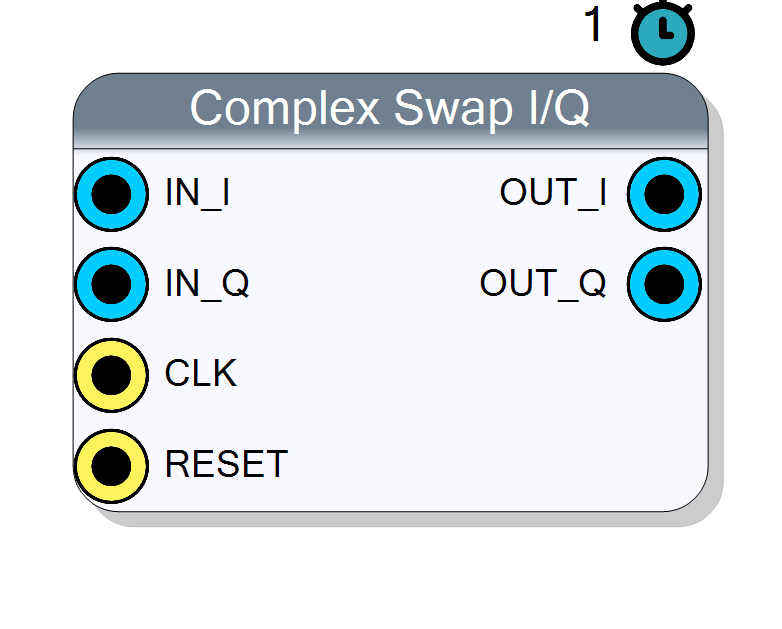
The Complex Swap I/Q block exchanges the two channels of a complex baseband sample:
OUT_I[n] = IN_Q[n]
OUT_Q[n] = IN_I[n]
Equivalently, with X = IN_I + j*IN_Q,
OUT = IN_Q + j*IN_I = j * conj(X)
This is a pure wire crossover: no arithmetic, no bit growth. Data is signed two’s complement.
Pin Description
Properties
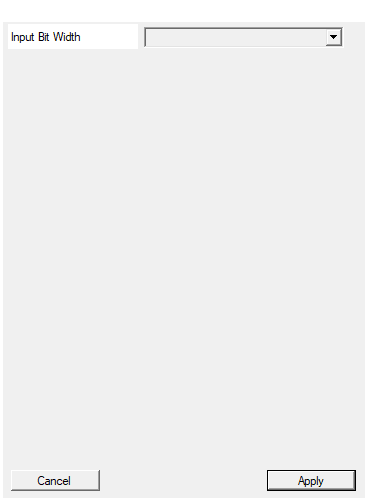
Bit width of each I/Q sample (signed).
Bit width of each signed I / Q sample. Range 4 to 32, default 16. The output width equals the input width.Default: 16
Options: 4 5 6 7 8 9 10 11 12 13 14 15 16 17 18 19 20 21 22 23 24 25 26 27 28 29 30 31 32
Usage
Bit widths
Data is signed two’s complement and the width is unchanged.
IN_I,IN_Q: signedInputSizebits.OUT_I,OUT_Q: signedInputSizebits.
Interpretation
Swapping I and Q is equivalent to j * conj(X): it conjugates the phasor
(flipping the spectrum) and then rotates it by +90 degrees. It is the
simplest way to correct an inverted I/Q wiring convention between two
blocks that disagree on the sign of the imaginary axis.
Latency and throughput
#pragma HLS PIPELINE II=1: one sample pair per clock.- 1-clock latency.
- All data ports use the
ap_noneinterface (no ready/valid handshake); the core is free-running (ap_ctrl_none).
Reset
RESET is the HLS synchronous reset (ap_rst).
Typical applications
- I/Q convention fix between blocks with opposite imaginary-axis sign.
- Spectrum flip combined with a 90-degree relabel (
j*conj(X)). - Quick +/-90-degree rotate without a multiplier.
Resources & Timing
-
Latency: 1 clock cycle
-
Throughput: 1 sample per clock (II=1)
Zero DSPs and zero LUTs of logic: a pure wire crossover. Implemented with Vitis HLS. Free-running core (ap_ctrl_none), no handshake logic.