
Logic NOT [TM]
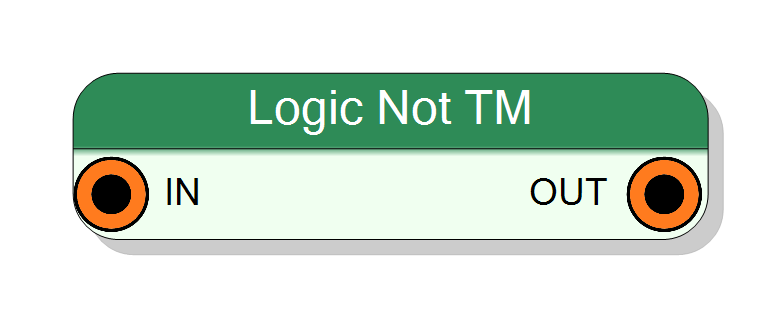
Time-multiplexed bitwise NOT operation. Inverts all bits of the input signal. Supports TM factors from 2 to 32. Pure combinational logic (zero latency).
Introduction
This block performs a bitwise NOT (inversion) operation on time-multiplexed (TM) data streams. Each bit of the input is inverted: 0 becomes 1, and 1 becomes 0.
The operation is purely combinational with zero clock latency:
$$ \mathrm{OUT}(n) = \lnot \mathrm{IN}(n), $$
where $\lnot$ represents the logical NOT operation. The TM Factor property determines how many parallel samples are processed per clock cycle.
Pin Description
Inverted output, always TM (same factor as IN).
Width: Input Size × TM Factor
Output is combinational (zero latency).
Input Size × TM Factor
Each TM phase receives its corresponding slice of the input bus.
Properties
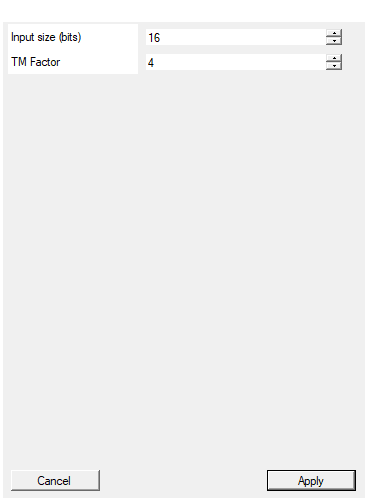
Set the size of each input in bits
Number of bits per input sample. Range: 1 – 16384. Each TM phase processes samples of this width.Default: 16
Range: 1 – 16384
Time Multiplexing factor (number of phases)
Time-multiplexing factor (number of parallel phases). Allowed values: 2 – 32. Higher values increase throughput proportionally but consume more FPGA resources.Default: 4
Range: 2 – 32
Functional description
The component implements a bitwise NOT gate in VHDL, replicated N times (where N = TM Factor) to support time-multiplexed data streams.
For each TM phase and each bit position:
$$ y[i] = \lnot x[i], $$
where:
- $x[i]$ → input bit $i$
- $y[i]$ → output bit $i$
- $\lnot$ → logical NOT operation
The NOT gate is the fundamental inversion operation in digital logic. Truth table:
| IN | OUT |
|---|---|
| 0 | 1 |
| 1 | 0 |
Applications
- Bitwise inversion for signal polarity reversal
- Creating active-low signals from active-high (or vice versa)
- Building blocks for XOR and other logic gates
- Bit masking and complement generation
Mathematical background
The NOT operation is the logical negation in Boolean algebra:
$$ \lnot 0 = 1, \quad \lnot 1 = 0 $$
For multi-bit vectors, NOT is applied bit-wise:
$$ \lnot(b_{n-1} b_{n-2} \ldots b_1 b_0) = (\lnot b_{n-1})(\lnot b_{n-2}) \ldots (\lnot b_1)(\lnot b_0) $$
Timing
The component is purely combinational with zero latency:
| Property | Latency (clock cycles) |
|---|---|
| Logic NOT TM | 0 |
All TM phases are processed in parallel within the same clock cycle.
Typical use cases
- Signal polarity inversion in trigger logic
- Creating complementary signals
- Bitwise masking operations
- Building complex logic functions