
Integer To Binary
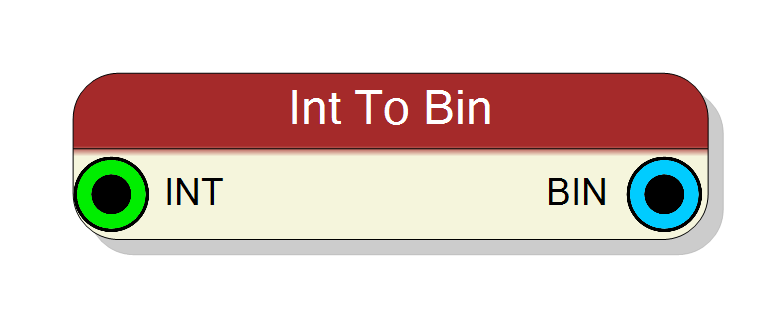
Converts a VHDL INTEGER type signal to a std_logic_vector binary representation. The component translates the 32-bit signed INTEGER type into a configurable-width binary vector with selectable signed or unsigned interpretation. Pure combinational logic with zero latency.
Introduction
This block converts a VHDL INTEGER type signal to a std_logic_vector binary representation. It allows you to interface between VHDL’s high-level INTEGER type and the bit-level std_logic_vector type commonly used in digital design.
The operation is purely combinational with zero clock latency:
$$ \mathrm{BIN} = \mathrm{INT}[N-1:0], $$
where $N$ is the Output bits parameter (2 to 32 bits). The output can be configured as either SIGNED or UNSIGNED representation.
Pin Description
Output binary vector, always std_logic_vector. Width: Configurable via Output bits property (2 to 32 bits) Interpretation: Configurable via Output sign property
Output is combinational (zero latency).
Properties
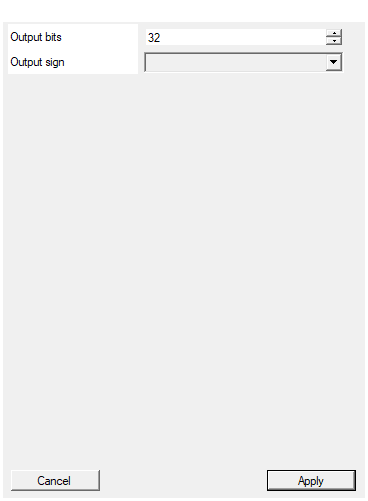
Set the number of bits of the binary output
Number of bits in the binary output vector (2 to 32 bits). For full INTEGER range preservation, use 32 bits.Default: 32
Range: 2 – 32
Select the sign/unsign of the binary output
Interpretation of the output binary vector: UNSIGNED (0 to 2^N-1) or SIGNED (two’s complement, -2^(N-1) to 2^(N-1)-1).Default: UNSIGNED
Options: UNSIGNED SIGNED
Functional description
The component performs a direct type conversion from VHDL’s INTEGER type to std_logic_vector. In VHDL, the INTEGER type is defined as a 32-bit signed integer with range -2,147,483,648 to 2,147,483,647.
Conversion process
The conversion extracts the lower $N$ bits from the INTEGER value:
$$ \mathrm{BIN}[N-1:0] = \mathrm{INT}[N-1:0] $$
where:
- $N$ → Output bits (2 to 32)
- INT → Input INTEGER value
- BIN → Output binary vector
Signed vs Unsigned output
The Output sign property determines how the output should be interpreted:
-
UNSIGNED: Output represents values 0 to $2^N - 1$
- Negative input integers will wrap around (two’s complement preserved)
- Example: -1 becomes 0xFFFFFFFF (32 bits)
-
SIGNED: Output represents values $-2^{N-1}$ to $2^{N-1} - 1$
- MSB is the sign bit
- Two’s complement representation
- Example: -1 becomes 0xFFFFFFFF (32 bits)
Range considerations
- If the INTEGER value exceeds the output bit width range, truncation occurs
- For $N < 32$ bits, only the lower $N$ bits are extracted
- The sign bit (bit 31) is preserved in the MSB only if $N = 32$
Example conversions
For a 16-bit UNSIGNED output:
- INT = 42 → BIN = 0x002A
- INT = -1 → BIN = 0xFFFF (wraps to 65535)
- INT = 256 → BIN = 0x0100
For an 8-bit SIGNED output:
- INT = 42 → BIN = 0x2A
- INT = -1 → BIN = 0xFF
- INT = 127 → BIN = 0x7F
- INT = -128 → BIN = 0x80
- INT = 256 → BIN = 0x00 (truncated)
Timing
The component is purely combinational with zero latency:
| Property | Latency (clock cycles) |
|---|---|
| Integer To Binary | 0 |
Output is available immediately in the same clock cycle.
Typical use cases
- Converting integer constants to binary vectors
- Interfacing between arithmetic units and bit-level logic
- Extracting bit fields from integer values
- Type conversion for component interfacing