
Constant Bit-Vector
Generates a constant bit-vector value with configurable width. Supports hexadecimal (0x…), binary (0b…), and decimal input formats. Useful for providing fixed digital patterns, masks, or lookup table values in FPGA designs. Pure combinational logic (zero latency).
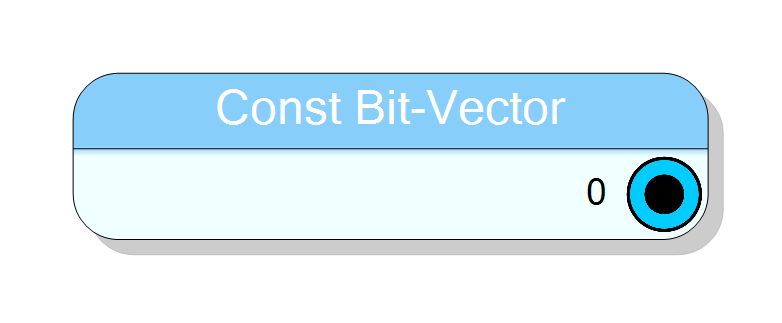
Introduction
This block generates a constant bit-vector value that remains fixed throughout operation. The constant is defined at design time and synthesized directly into the FPGA logic as a hardwired value.
The component accepts values in multiple formats:
- Hexadecimal:
0xFF,0x100,0xDEADBEEF - Binary:
0b10101010,0b11110000 - Decimal:
255,1024,3735928559
The output is a purely combinational constant with zero clock latency, available immediately after FPGA configuration.
Pin Description
Constant bit-vector output, always combinational (zero latency). Width: Configurable via BitSize property (1 to 10,000,000,000 bits).
The output value is fixed at design time and remains constant during operation. No clock or enable signals required.
Properties
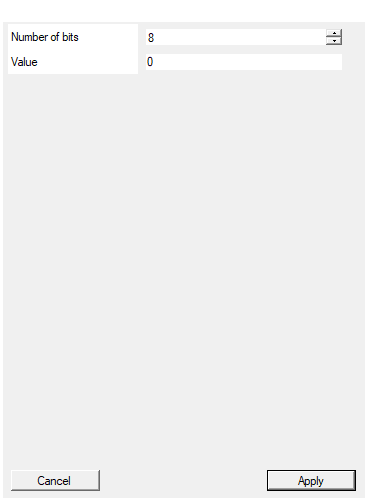
Set the number of bits for the output constant signal
Number of bits in the output constant bit-vector. Range: 1 to 10,000,000,000. Determines the width of the CONST output pin.Default: 8
Set the value of the constant. Use 0x
Default: 0
Functional description
The component implements a constant bit-vector source in VHDL. The value is defined at compile time and hardwired into the design:
$$ \mathrm{CONST} = V $$
where $V$ is the user-specified constant value, represented as a bit-vector of configurable width.
Value formats
The component supports three input formats:
-
Hexadecimal (
0xprefix): Most compact for large valuesValue: 0xFF → 8-bit: "11111111" Value: 0x1234 → 16-bit: "0001001000110100" -
Binary (
0bprefix): Explicit bit-by-bit specificationValue: 0b10101010 → 8-bit: "10101010" Value: 0b1111 → 4-bit: "1111" -
Decimal (no prefix): Standard integer notation
Value: 255 → 8-bit: "11111111" Value: 1024 → needs ≥11 bits
Bit width and truncation
The BitSize property determines the output width. If the specified value
requires more bits than BitSize, the VHDL resize function automatically
truncates the most significant bits:
Value: 0x1FF (9 bits needed)
BitSize: 8
Result: 0xFF (MSB truncated)
If the value is smaller than BitSize, it is zero-extended to the left:
Value: 0xF (4 bits)
BitSize: 8
Result: 0x0F (zero-extended)
Implementation details
The VHDL implementation uses different conversion methods based on the input format:
- Hexadecimal:
std_logic_vector(resize(unsigned'(x"..."), BitSize)) - Binary:
std_logic_vector(resize(unsigned'("..."), BitSize)) - Decimal:
conv_std_logic_vector(value, BitSize)
All formats guarantee correct bit-width matching through automatic resizing.
Timing
The component is purely combinational with zero latency:
| Property | Latency (clock cycles) |
|---|---|
| Constant Bit-Vector | 0 |
The output is available immediately after FPGA configuration and does not depend on any clock signal.
Typical use cases
- Bit masks: Define fixed patterns for masking operations (e.g.,
0xFF00) - Lookup table initialization: Provide constant indices or addresses
- Protocol constants: Define fixed headers, magic numbers, or identifiers
- Test vectors: Generate known patterns for simulation and verification
- Default values: Supply reset or initialization values to other components
- Bit field manipulation: Create constants for setting/clearing specific bits
Example configurations
Example 1: 8-bit hexadecimal mask
BitSize: 8
Value: 0xAA
Output: "10101010" (alternating bits)
Example 2: 16-bit protocol header
BitSize: 16
Value: 0xFACE
Output: "1111101011001110" (fixed packet header)
Example 3: Binary bit pattern
BitSize: 4
Value: 0b1010
Output: "1010" (explicit bit pattern)
Example 4: Decimal constant
BitSize: 12
Value: 2048
Output: "100000000000" (2^11)