
Majority
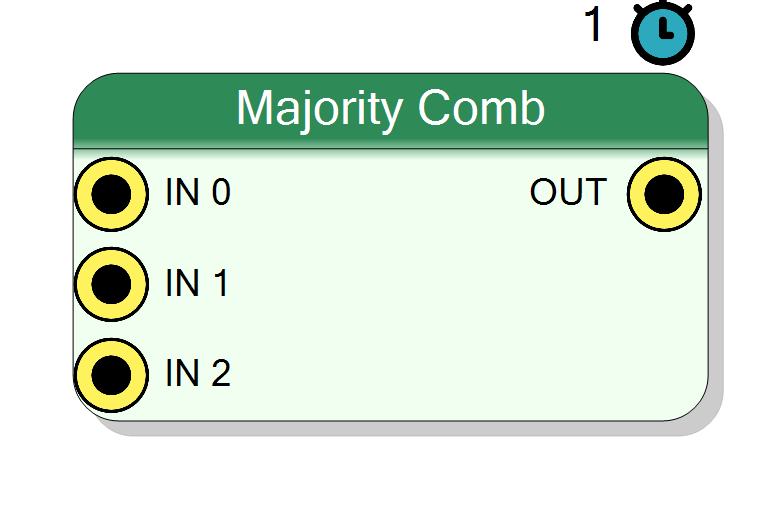
Majority voting logic gate. Returns 1 if half or more of the inputs are 1, otherwise returns 0. Configurable from 2 to 8 inputs. Combinational version with zero latency. Used for fault tolerance and noise rejection.
Introduction
This block implements a majority voting logic gate. It evaluates multiple single-bit inputs and produces a single-bit output based on the majority rule.
Operation:
- Output = 1 if half or more of the inputs are 1
- Output = 0 otherwise
The operation is purely combinational with zero clock latency. The number of inputs is configurable from 2 to 8 at component creation time.
For $N$ inputs with $M$ inputs at logic 1:
$$ \mathrm{OUT} = \begin{cases} 1 & \text{if } M \geq \lceil N/2 \rceil \ 0 & \text{otherwise} \end{cases} $$
Pin Description
Properties
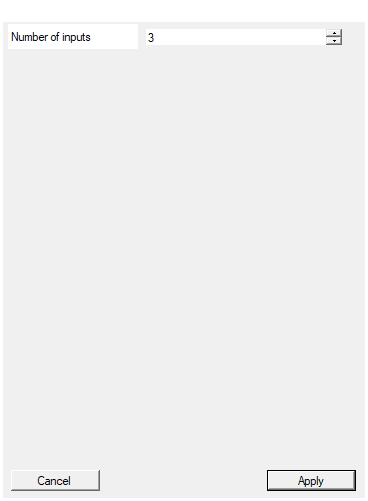
Set the number of input signals
Number of input signals for majority voting. Range: 2 to 8. This property is set during block creation and defines the voting threshold (ceiling of InputSize/2).Default: 3
Range: 2 – 8
Functional description
The component implements majority voting logic in VHDL. It counts the number of active (1) inputs and compares it to the majority threshold:
$$ y = \begin{cases} 1 & \text{if } \sum_{i=0}^{N-1} x[i] \geq \lceil N/2 \rceil \ 0 & \text{otherwise} \end{cases} $$
where:
- $x[i]$ → input bit $i$
- $y$ → output bit
- $N$ → total number of inputs (2-8)
- $\lceil N/2 \rceil$ → majority threshold (ceiling of N/2)
Truth tables for common configurations
2-input majority (threshold = 1):
| IN0 | IN1 | OUT |
|---|---|---|
| 0 | 0 | 0 |
| 0 | 1 | 1 |
| 1 | 0 | 1 |
| 1 | 1 | 1 |
3-input majority (threshold = 2):
| IN0 | IN1 | IN2 | OUT |
|---|---|---|---|
| 0 | 0 | 0 | 0 |
| 0 | 0 | 1 | 0 |
| 0 | 1 | 0 | 0 |
| 0 | 1 | 1 | 1 |
| 1 | 0 | 0 | 0 |
| 1 | 0 | 1 | 1 |
| 1 | 1 | 0 | 1 |
| 1 | 1 | 1 | 1 |
Mathematical background
Majority voting is a fundamental concept in:
- Fault tolerance: Triple modular redundancy (TMR) and higher
- Noise rejection: Multiple sensor voting for reliability
- Error correction: Majority logic decoding
- Byzantine agreement: Distributed consensus algorithms
The majority function returns the most common value among the inputs, providing resilience against single-point failures or noise.
Timing
The component is purely combinational with zero latency:
| Property | Latency (clock cycles) |
|---|---|
| Majority | 0 |
The output changes immediately (after propagation delay) when any input changes.
Typical use cases
- Triple modular redundancy (TMR) for fault tolerance
- Multi-sensor voting for noise immunity
- Redundant detector signal combination
- Error detection and correction circuits
- Safety-critical systems requiring redundancy