
Uniform Random
Uniform pseudo-random word generator: one new word per CE clock, output width from 2 to 64 bit, three selectable algorithms (xoshiro256**, Tausworthe LFSR258, XorShift64). The 128-bit seed is auto-randomized when the block is placed, so multiple instances produce independent streams, and stays editable for reproducible runs; RESET restarts the sequence identically. Pure VHDL, no DSP, no BRAM.
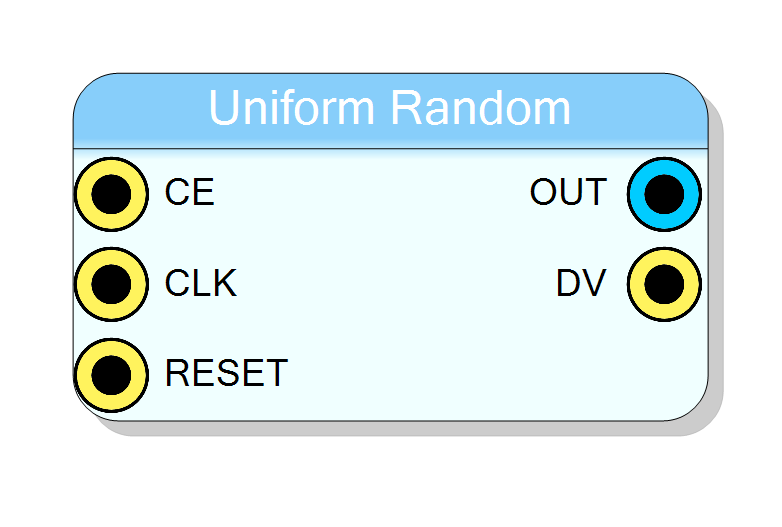
Introduction
The block produces a stream of uniformly distributed pseudo-random words:
a new word on every clock where CE is high (DV marks it). The output
is the top OUT bits of a 64-bit generator word, so the same stream is
uniform whether you read it as unsigned $[0, 2^W-1]$ or as two’s
complement $[-2^{W-1}, 2^{W-1}-1]$ — the bit pattern is format agnostic.
Three generator cores are available, all pure logic (shift, XOR, add — no DSP, no BRAM):
- XOSHIRO256** (recommended) — Blackman/Vigna xoshiro256**. Period $2^{256}-1$, passes the modern statistical test suites (the multiplications by 5 and 9 are implemented as shift-adds). This is the “whitest” option: use it whenever statistical quality matters (noise floors, Monte-Carlo stimuli, dithering).
- Tausworthe LFSR258 — L’Ecuyer’s 5-component combined Tausworthe, 64 bit, period $\approx 2^{258}$, maximally equidistributed. The classic FPGA generator family (the Gaussian Noise block uses a 32-bit sibling internally).
- XorShift64 — Marsaglia’s 13/7/17 xorshift, period $2^{64}-1$, a single 64-bit register: the smallest option. Being one linear recurrence it fails linear-complexity style tests — fine as a cheap generic stimulus, prefer xoshiro for measurements.
Seeding and reproducibility
The 128-bit SEED property is randomized automatically when the block is
placed, so several generators in one design are decorrelated out of the
box. The seed is expanded to the full generator state (up to 5 x 64 bit)
with SplitMix64 — the canonical seeding procedure — and degenerate states
are sanitized automatically. Set two instances to the same seed to get
two identical streams; RESET reloads the seed, so the sequence restarts
from the beginning and simulations are deterministic.
Pin Description
Properties
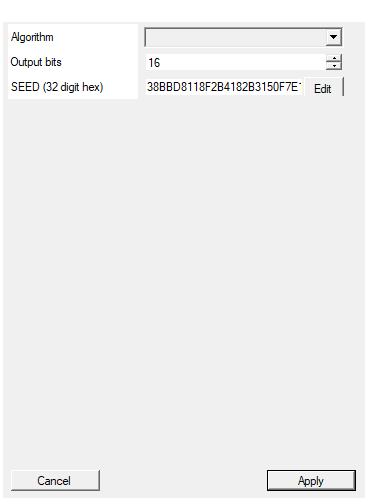
Pseudo-random generator core. XOSHIRO256** (recommended): period 2^256-1, best statistical quality, no DSP. Tausworthe LFSR258: period ~2^258, the classic FPGA combined Tausworthe. XorShift64 (smallest): period 2^64-1, one 64-bit register, cheapest - fine as a simple stimulus.
- XOSHIRO256** (recommended): period 2^256-1, best statistical quality, no DSP.
- Tausworthe LFSR258: period ~2^258, the classic FPGA combined Tausworthe.
- XorShift64 (smallest): period 2^64-1, one 64-bit register - cheapest, fine as a simple stimulus.
Default: XOSHIRO256** (recommended)
Options: XOSHIRO256** (recommended) Tausworthe LFSR258 XorShift64 (smallest)
Width of the OUT word (2..64): the top bits of the 64-bit generator word. Uniform whether read as unsigned [0 .. 2^W-1] or two’s complement [-2^(W-1) .. 2^(W-1)-1].
Width of OUT (2..64): the top bits of the generator word.Default: 16
Range: 2 – 64
Generator seed (128 bit, 32 hex digits), expanded internally to the full generator state with SplitMix64. Automatically randomized when the component is created, so multiple instances produce independent streams; set two instances to the same seed to get identical streams. RESET restarts the sequence from the seed.
128-bit seed as 32 hex digits. Auto-randomized when the component is created (independent instances); editable for reproducible streams. Expanded internally to the full generator state with SplitMix64; degenerate values are sanitized automatically.Default: 38BBD8118F2B4182B3150F7E1E022141
Usage notes
- Leaving
CEunconnected ties it to ‘1’: one word every clock. - For a bipolar noise source just treat OUT as signed: the stream is already symmetric around zero. For unipolar, treat it as unsigned.
- A 1-bit output (OutputBits can be dropped by taking fewer bits downstream) gives an unbiased random bit stream.
- Chain the output into the Shapers IIR filters to spectrally shape the noise; the stream is white (flat) at the full clock rate.
Verification
Each algorithm is checked bit-exactly against an independent Python reference implementation (golden vectors, first words after reset), plus CE gating, reset-restart, output slicing and a statistical smoke test (per-bit balance over 4096 words, no repeated consecutive words) in a self-checking GHDL regression; mutation-tested (a wrong rotation, tap or mask in any of the three cores makes its scenario fail).