
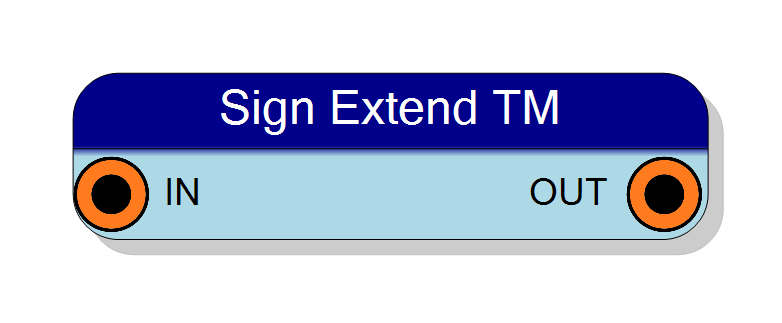
Sign Extend [TM]
Time-multiplexed sign extension operation that increases bit width while preserving sign and value for two’s complement signed numbers. Replicates the sign bit (MSB) to fill additional bits. Supports TM factors from 2 to 32. Pure combinational logic (zero latency).
Introduction
This block performs sign extension on time-multiplexed (TM) data streams. It extends signed two’s complement numbers to wider formats while preserving both the sign and numeric value.
The operation is purely combinational with zero latency. The sign bit (MSB) is replicated to fill all additional MSB positions in the wider output.
This block is used for signed two’s complement numbers only. For unsigned numbers, use Zero Fill instead.
The TM Factor property determines how many parallel samples are processed per clock cycle.
Pin Description
Input Width × TM Factor
MSB is the sign bit.
Output Size × TM Factor
Output is combinational (zero latency).
Sign and value are preserved.
Properties
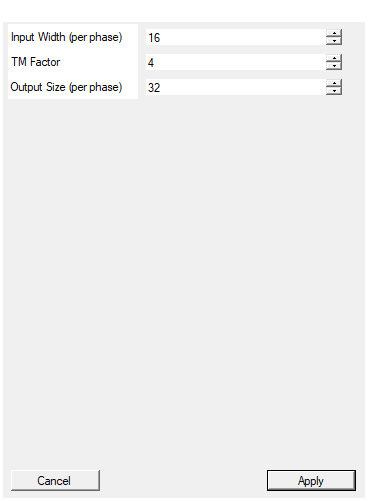
Set the input word size in bits per phase
Number of bits per input sample. Range: 2 – 128. Must be ≤ Output Size. MSB is treated as the sign bit.Default: 16
Range: 2 – 128
Set the time multiplexing factor (number of phases)
Time-multiplexing factor (number of parallel phases). Allowed values: 2, 4, 8, 16, 32.Default: 4
Range: 2 – 32
Set the output word size in bits per phase
Number of bits per output sample. Range: 0 – 128. Must be ≥ Input Width. Additional MSBs are filled with sign bit.Default: 32
Range: 0 – 128
Functional description
The component implements sign extension in VHDL, replicated N times (where N = TM Factor) to support time-multiplexed data streams.
For each TM phase:
- Input width = Input Width bits
- Output width = Output Size bits (must be ≥ Input Width)
- Sign bit = Input MSB (bit Input Width - 1)
- Extension = Replicate sign bit into all additional MSB positions
Operation
Sign extension preserves the value of two’s complement signed numbers:
$$ y[W_{\text{out}}-1 : W_{\text{in}}] = \text{replicate}(x[W_{\text{in}}-1]) $$
$$ y[W_{\text{in}}-1 : 0] = x[W_{\text{in}}-1 : 0] $$
Examples
Positive number:
- 8-bit:
01101100(+108) → 16-bit:00000000 01101100(+108) - Sign bit (0) replicated to fill upper 8 bits
Negative number:
- 8-bit:
11010110(-42) → 16-bit:11111111 11010110(-42) - Sign bit (1) replicated to fill upper 8 bits
Mathematical background
Sign extension preserves the numeric value in two’s complement representation:
For an N-bit signed number $x$ extended to M bits (M > N): $$ \text{value}(x_{\text{extended}}) = \text{value}(x) $$
Common uses:
- Signed integer width conversion (8→16, 16→32 bits)
- Fixed-point signed arithmetic width adaptation
- ALU operand size normalization
- Communication protocol signed data conversion
Timing
The component is purely combinational with zero latency:
| Property | Latency (clock cycles) |
|---|---|
| Sign Extend TM | 0 |
All TM phases are processed in parallel within the same clock cycle.
Typical use cases
- Signed integer width conversion (8→16, 16→32 bits)
- Fixed-point signed arithmetic width adaptation
- DSP pipeline operand size normalization
- Two’s complement data format conversion
- Signed audio/video sample processing