
Triangular Noise
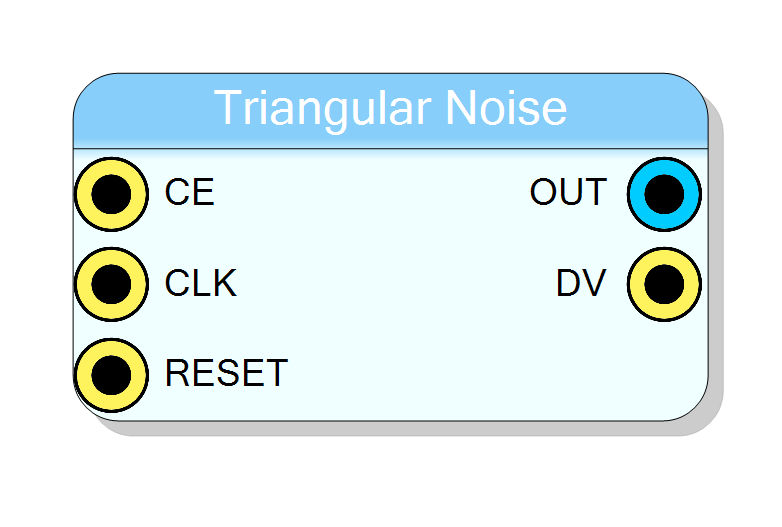
Triangular-distributed noise source, one sample per CE clock: the mean of two independent uniforms from an embedded xoshiro256** generator. Signed, zero-centered, peak at 0, width from a property (2..32 bit). Auto-random seed per instance, RESET restarts the sequence. Pure VHDL, no DSP.
Introduction
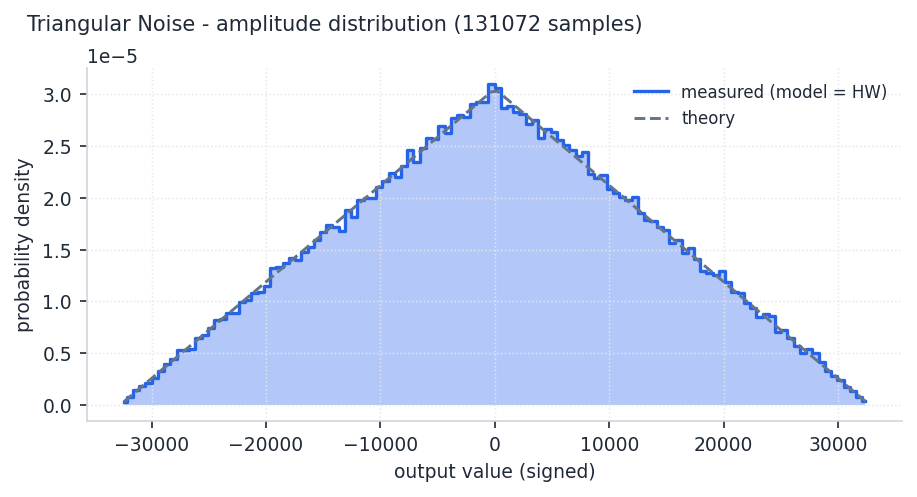
Every CE clock the block outputs $(u_1 + u_2)/2$ where $u_1, u_2$ are
two independent uniform samples (the two halves of one 64-bit xoshiro
word): a triangular PDF over the full signed range, the classic dither
distribution (TPDF). The spectrum is white.
The distribution below is measured on the bit-exact model the hardware is verified against (GHDL golden regression):
Pin Description
Properties
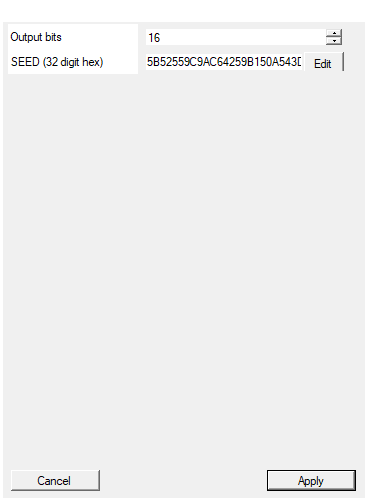
Width of the OUT word (2..32), signed.
Output width (2..32), signed.Default: 16
Range: 2 – 32
Seed of the embedded white generator (128 bit hex), expanded internally with SplitMix64. Auto-randomized when the component is created, so multiple instances produce independent noise; editable for reproducible runs. RESET restarts the sequence. Triangular amplitude distribution (mean of two uniforms), signed, zero-centered.
128-bit seed of the embedded white generator (auto-randomized at placement, editable).Default: 5B52559C9AC64259B150A543DDE62757
Usage
The seed is auto-randomized when the block is placed (independent
instances) and editable for reproducible runs; RESET restarts the
sequence identically. Leaving CE unconnected ties it to ‘1’.