
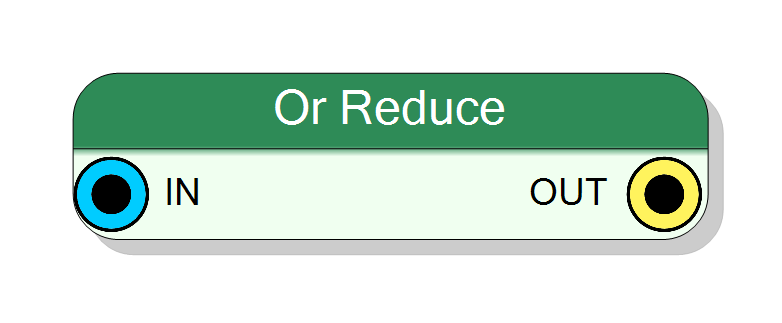
OR Reduce
Reduces a multi-bit input vector to a single bit using OR operation. Output is 1 if at least one input bit is 1, otherwise 0 (all bits are 0). Useful for checking if any bit in a vector is set. Pure combinational logic (zero latency).
Introduction
This block implements an OR reduction operation on a multi-bit input vector. It performs a logical OR across all bits of the input, producing a single-bit output.
The output is 1 (HIGH or True) if at least one input bit is 1. The output is 0 (LOW or False) only when the input vector contains all 0s.
The operation is purely combinational with zero clock latency:
$$ \mathrm{OUT} = \mathrm{IN}[0] \lor \mathrm{IN}[1] \lor \ldots \lor \mathrm{IN}[N-1], $$
where $\lor$ represents the logical OR operation and $N$ is the input bit width.
Pin Description
Properties
Functional description
The component implements an OR reduction operation in VHDL. It takes a multi-bit input vector and reduces it to a single bit by OR-ing all bits together:
$$ y = \bigvee_{i=0}^{N-1} x[i], $$
where:
- $x[i]$ → bit $i$ of the input vector
- $y$ → single-bit output
- $\bigvee$ → OR reduction operator
This is equivalent to checking if any bit is 1 in the input vector:
| Input Pattern | Output |
|---|---|
| All 0s | 0 |
| Any 1 | 1 |
Example
Given an 8-bit input:
00000000→ Output:0(all bits are 0)00000001→ Output:1(at least one bit is 1)10101010→ Output:1(multiple bits are 1)
Mathematical background
The OR reduction operation is a unary operator that combines all bits of a vector using the OR operation. It is commonly used in VHDL/Verilog for:
- Checking if any bit in a vector is set (non-zero detection)
- Validating that at least one condition is true
- Implementing “any true” conditions
- Zero detection (inverse of OR reduce)
Timing
The component is purely combinational with zero latency:
| Property | Latency (clock cycles) |
|---|---|
| OR Reduce | 0 |
The output changes immediately (after propagation delay) when the input changes.
Typical use cases
- Non-zero detection in data validation
- Checking if any error flag is set
- Implementing “any condition met” logic
- Bit-width reduction in status monitoring
- Activity detection across multiple signals