
Pink Noise
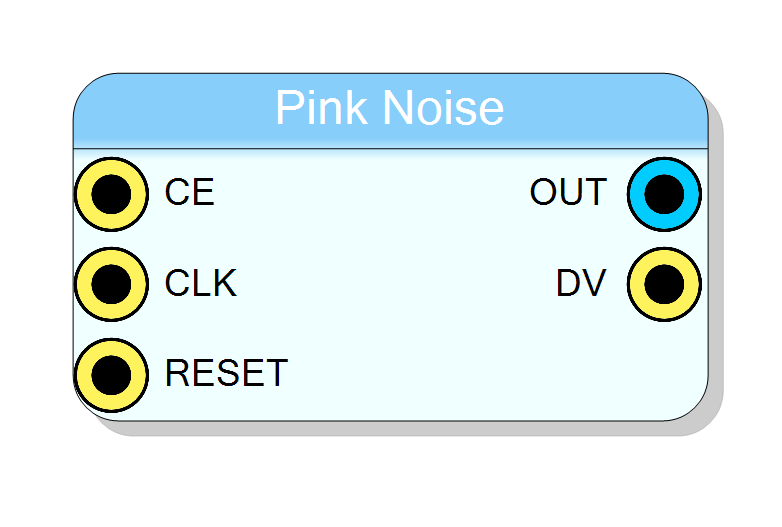
Pink (1/f) noise source, -3 dB/octave, one sample per CE clock: Voss-McCartney algorithm on an embedded white xoshiro256** source – N octave registers refreshed at halving rates plus an always-new term. Costs a handful of registers and one adder tree: no multipliers, no BRAM. Auto-random per-instance seed, RESET restarts the sequence.
Introduction
Pink noise has equal power per octave ($1/f$ PSD, -3 dB/oct) – the spectrum of flicker noise and the standard wideband test stimulus. The Voss-McCartney construction sums Octaves random registers where register $j$ is refreshed with new white every $2^j$ samples: each register contributes one octave band, and the sum approximates $1/f$ within ~0.5 dB over the covered octaves.
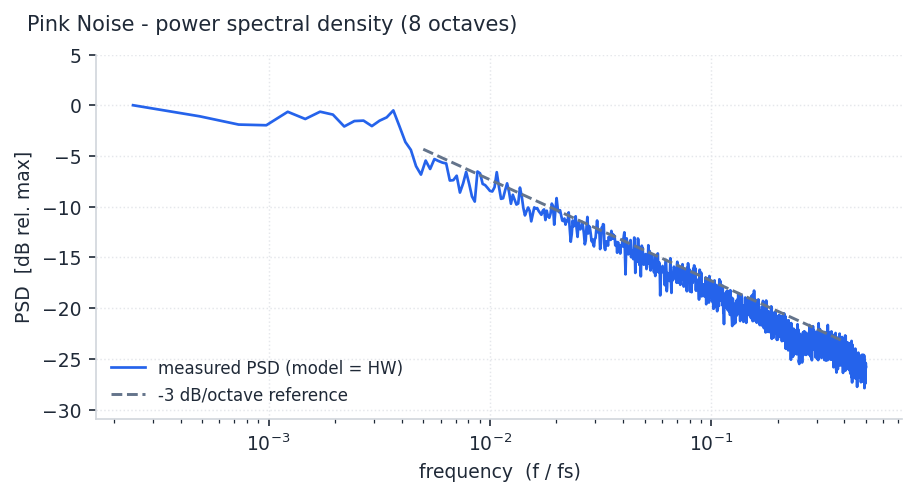
Measured on the bit-exact model the hardware is verified against; the dashed line is the ideal -3 dB/octave slope. Below $f_s/2^{Octaves}$ the spectrum flattens to white – add octaves to push the corner down (16 octaves at 100 MHz reaches ~1.5 kHz).
Pin Description
Properties
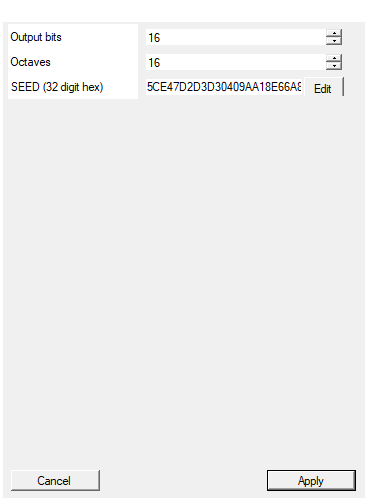
Width of the OUT word (2..32), signed.
Output width (2..32), signed, saturated.Default: 16
Range: 2 – 32
Number of Voss-McCartney octave registers: the -3 dB/oct slope holds from fs/2 down to fs/2^Octaves (flat/white below).
Voss-McCartney octave registers (4..24): -3 dB/oct holds from fs/2 down to fs/2^Octaves.Default: 16
Range: 4 – 24
Seed of the embedded white generator (128 bit hex), expanded internally with SplitMix64. Auto-randomized when the component is created, so multiple instances produce independent noise; editable for reproducible runs. RESET restarts the sequence. Pink 1/f noise, -3 dB/octave (Voss-McCartney).
128-bit seed of the embedded white generator (auto-randomized at placement, editable).Default: 5CE47D2D3D30409AA18E66A84EC535B5
Usage
Output = sum of the Octaves+1 terms, normalized (shift) and saturated
to OutputBits. One sample per CE clock, one clock latency. CE
defaults to ‘1’.