
Fixed P. Rect to Polar TM
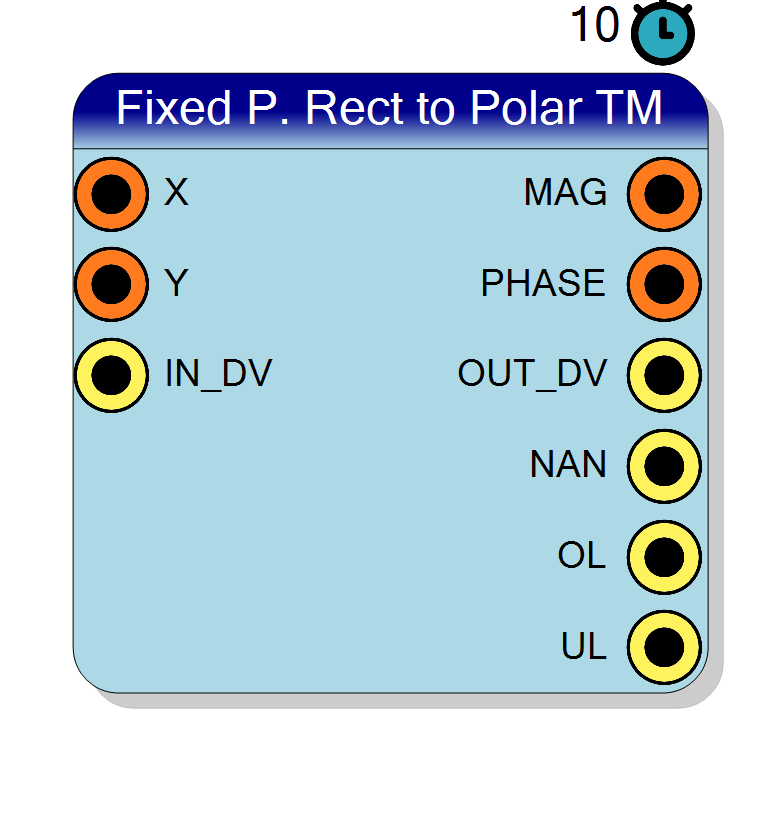
Full rectangular to polar conversion: magnitude and phase from one CORDIC pass, instead of instantiating a Magnitude and an Atan2 block separately.
Introduction
The block computes, in fixed-point arithmetic,
$$
\mathrm{MAG} = \sqrt{X^2+Y^2}, \quad \mathrm{PHASE} = \operatorname{atan2}(Y, X)
$$
This is the time-multiplexed variant: the X port carries TM samples packed
side by side in one wide vector, and the same operation is applied to every slot in
the same clock cycle. The scalar variant fixedp_r2p is identical apart from the
packing.
Operand Y can either be time-multiplexed as well (slot by slot operation) or a
single scalar broadcast to every slot, selected by the B_IsTM property.
Every operand and every result carries its own Q format: the number of integer bits, the number of fractional bits and the sign are chosen independently. The binary point is tracked through the whole datapath, so operands with different scaling are aligned automatically – no manual shifting is required, which is the main practical difference with respect to the integer-only arithmetic blocks.
Input domain. At the origin the magnitude is zero and the phase is reported as zero.
Pin Description
Properties
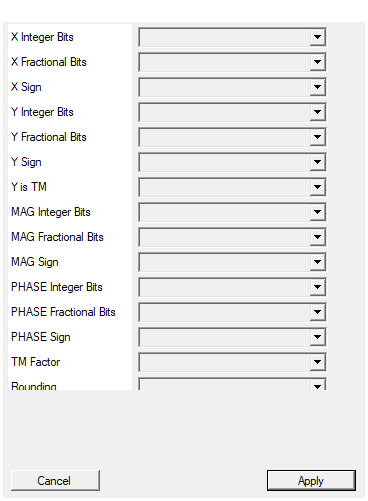
Number of INTEGER bits of X (the sign, when present, uses one of them).
Number of INTEGER bits of the operandX (1 to 64). When the port is SIGNED one
of these bits carries the sign.
Default: 16
Options: 1 2 3 4 5 6 7 8 9 10 11 12 13 14 15 16 17 18 19 20 21 22 23 24 25 26 27 28 29 30 31 32 33 34 35 36 37 38 39 40 41 42 43 44 45 46 47 48 49 50 51 52 53 54 55 56 57 58 59 60 61 62 63 64
Number of FRACTIONAL bits of X, i.e. how many bits sit to the right of the binary point. Total width = integer + fractional bits.
Number of FRACTIONAL bits of the operandX (0 to 64), i.e. the bits to the right
of the binary point. Total port width = integer + fractional bits.
Default: 0
Options: 0 1 2 3 4 5 6 7 8 9 10 11 12 13 14 15 16 17 18 19 20 21 22 23 24 25 26 27 28 29 30 31 32 33 34 35 36 37 38 39 40 41 42 43 44 45 46 47 48 49 50 51 52 53 54 55 56 57 58 59 60 61 62 63 64
Select whether X is a signed (two’s complement) or unsigned quantity.
Arithmetic type of X:
- SIGNED – two’s complement, range $[-2^{N_{int}-1}, 2^{N_{int}-1})$
- UNSIGNED – non negative only, range $[0, 2^{N_{int}})$
Default: SIGNED
Options: UNSIGNED SIGNED
Number of INTEGER bits of Y (the sign, when present, uses one of them).
Number of INTEGER bits of the operandY (1 to 64). When the port is SIGNED one
of these bits carries the sign.
Default: 16
Options: 1 2 3 4 5 6 7 8 9 10 11 12 13 14 15 16 17 18 19 20 21 22 23 24 25 26 27 28 29 30 31 32 33 34 35 36 37 38 39 40 41 42 43 44 45 46 47 48 49 50 51 52 53 54 55 56 57 58 59 60 61 62 63 64
Number of FRACTIONAL bits of Y, i.e. how many bits sit to the right of the binary point. Total width = integer + fractional bits.
Number of FRACTIONAL bits of the operandY (0 to 64), i.e. the bits to the right
of the binary point. Total port width = integer + fractional bits.
Default: 0
Options: 0 1 2 3 4 5 6 7 8 9 10 11 12 13 14 15 16 17 18 19 20 21 22 23 24 25 26 27 28 29 30 31 32 33 34 35 36 37 38 39 40 41 42 43 44 45 46 47 48 49 50 51 52 53 54 55 56 57 58 59 60 61 62 63 64
Select whether Y is a signed (two’s complement) or unsigned quantity.
Arithmetic type of Y:
- SIGNED – two’s complement, range $[-2^{N_{int}-1}, 2^{N_{int}-1})$
- UNSIGNED – non negative only, range $[0, 2^{N_{int}})$
Default: SIGNED
Options: UNSIGNED SIGNED
YES: operand Y is time multiplexed like X. NO: it is a single scalar value broadcast to every TM slot.
- YES – operand
Yis time-multiplexed and is consumed slot by slot - NO – operand
Yis a single scalar broadcast to every TM slot
Default: YES
Options: NO YES
Number of INTEGER bits of MAG (the sign, when present, uses one of them).
Number of INTEGER bits of the resultMAG (1 to 64). When the port is SIGNED one
of these bits carries the sign.
Default: 17
Options: 1 2 3 4 5 6 7 8 9 10 11 12 13 14 15 16 17 18 19 20 21 22 23 24 25 26 27 28 29 30 31 32 33 34 35 36 37 38 39 40 41 42 43 44 45 46 47 48 49 50 51 52 53 54 55 56 57 58 59 60 61 62 63 64
Number of FRACTIONAL bits of MAG, i.e. how many bits sit to the right of the binary point. Total width = integer + fractional bits.
Number of FRACTIONAL bits of the resultMAG (0 to 64), i.e. the bits to the right
of the binary point. Total port width = integer + fractional bits.
Default: 0
Options: 0 1 2 3 4 5 6 7 8 9 10 11 12 13 14 15 16 17 18 19 20 21 22 23 24 25 26 27 28 29 30 31 32 33 34 35 36 37 38 39 40 41 42 43 44 45 46 47 48 49 50 51 52 53 54 55 56 57 58 59 60 61 62 63 64
Select whether MAG is a signed (two’s complement) or unsigned quantity.
Arithmetic type of MAG:
- SIGNED – two’s complement, range $[-2^{N_{int}-1}, 2^{N_{int}-1})$
- UNSIGNED – non negative only, range $[0, 2^{N_{int}})$
Default: SIGNED
Options: UNSIGNED SIGNED
Number of INTEGER bits of PHASE (the sign, when present, uses one of them).
Number of INTEGER bits of the resultPHASE (1 to 64). When the port is SIGNED one
of these bits carries the sign.
Default: 17
Options: 1 2 3 4 5 6 7 8 9 10 11 12 13 14 15 16 17 18 19 20 21 22 23 24 25 26 27 28 29 30 31 32 33 34 35 36 37 38 39 40 41 42 43 44 45 46 47 48 49 50 51 52 53 54 55 56 57 58 59 60 61 62 63 64
Number of FRACTIONAL bits of PHASE, i.e. how many bits sit to the right of the binary point. Total width = integer + fractional bits.
Number of FRACTIONAL bits of the resultPHASE (0 to 64), i.e. the bits to the right
of the binary point. Total port width = integer + fractional bits.
Default: 0
Options: 0 1 2 3 4 5 6 7 8 9 10 11 12 13 14 15 16 17 18 19 20 21 22 23 24 25 26 27 28 29 30 31 32 33 34 35 36 37 38 39 40 41 42 43 44 45 46 47 48 49 50 51 52 53 54 55 56 57 58 59 60 61 62 63 64
Select whether PHASE is a signed (two’s complement) or unsigned quantity.
Arithmetic type of PHASE:
- SIGNED – two’s complement, range $[-2^{N_{int}-1}, 2^{N_{int}-1})$
- UNSIGNED – non negative only, range $[0, 2^{N_{int}})$
Default: SIGNED
Options: UNSIGNED SIGNED
Time multiplexing factor
Time multiplexing factor: 4, 8, 16 or 32 samples packed per port. One operator instance is generated per slot.Default: 4
Options: 4 8 16 32
ROUND: round to nearest when discarding fractional bits. TRUNCATE: drop them (cheaper, adds a DC bias).
- ROUND – round to nearest when discarding fractional bits
- TRUNCATE – discard them (cheaper, introduces a negative bias)
Default: ROUND
Options: TRUNCATE ROUND
YES: clip to the largest representable output value on overflow. NO: wrap around (cheaper, but overflow changes sign).
- YES – clip to the largest representable output value on overflow
- NO – wrap around modulo the output width
Default: YES
Options: NO YES
YES: the block exposes three extra 1-bit outputs, valid together with OUT_DV – NAN (the result is mathematically undefined for the operands presented, or the operand had to be clamped into the convergence domain of the algorithm), OL (overflow: the true result left the output format and was saturated), and UL (underflow: the true result was not zero but requantized to zero). NO: the pins are not generated and the logic that produces them is not synthesised.
Default: YES
Options: NO YES
Unit used by the angle port: RADIANS, TURNS (1.0 = full circle) or DEGREES.
Unit of the angle port:
- RADIANS – the usual $[-\pi, \pi]$ convention
- TURNS – 1.0 is a full circle; this is the native internal unit, so it avoids the multiplication by $1/2\pi$ and is the most accurate choice
- DEGREES – 360.0 is a full circle
Default: RADIANS
Options: RADIANS TURNS DEGREES
Number of CORDIC rotations. Each iteration adds roughly one bit of accuracy and one adder stage; there is no point going far beyond the number of output fractional bits.
Number of CORDIC iterations (8 to 32). Roughly one bit of accuracy per iteration; there is little benefit in exceeding the number of fractional bits of the result.Default: 20
Options: 8 9 10 11 12 13 14 15 16 17 18 19 20 21 22 23 24 25 26 27 28 29 30 31 32
Fixed latency of the block, in clock cycles. More stages ease timing closure. Ignored in SERIAL mode, where the latency is set by the iteration count.
Fixed latency of the block in clock cycles (1 to 8). Higher values ease timing closure without changing the numerical result.Default: 10
Options: 1 2 3 4 5 6 7 8
Functional description
$$ \mathrm{MAG} = \sqrt{X^2+Y^2}, \quad \mathrm{PHASE} = \operatorname{atan2}(Y, X) $$
where
X– input operand, format $Q_{X_BitsInt.X_BitsFract}$Y– input operand, format $Q_{Y_BitsInt.Y_BitsFract}$MAG– result, format $Q_{MAG_BitsInt.MAG_BitsFract}$PHASE– result, format $Q_{PHASE_BitsInt.PHASE_BitsFract}$
Fixed-point format
A value with $N_{int}$ integer bits and $N_{frac}$ fractional bits is stored on $N_{int} + N_{frac}$ bits and represents
$$ \text{value} = \frac{\text{raw integer}}{2^{N_{frac}}} $$
When the operand is SIGNED, one of the integer bits carries the sign (two’s complement). Each port is configured independently, so it is perfectly legal to feed a $Q_{16.0}$ signal and a $Q_{2.14}$ coefficient into the same block.
Implementation
One circular CORDIC vectoring iteration produces both outputs, so this costs about half of the two separate blocks. Each output has its own Q format.
The CordicIterations property sets the number of rotations. Each iteration is worth roughly one extra bit of accuracy and costs one adder stage, so there is no benefit in setting it much higher than the number of fractional bits of the result.
Rounding and overflow
Two properties control how the internal full precision result is reduced to the output format:
- Rounding –
ROUNDrounds to nearest when fractional bits are discarded,TRUNCATEsimply drops them. Truncation is cheaper but introduces a systematic negative bias, which accumulates in a long processing chain. - Saturation –
YESclips to the largest representable value,NOwraps around. Wrapping turns a small overflow into a full-scale sign flip, so saturation is strongly recommended for signal processing.
Time multiplexing
The wide ports carry TM samples packed from the least significant bits up:
bits [W-1 : 0] -> slot 0
bits [2W-1 : W] -> slot 1
...
bits [TM*W-1 : (TM-1)*W] -> slot TM-1
where W is the width of a single sample. One operator instance is generated per
slot, so the resource usage scales with the TM factor while the throughput stays
one full set of samples per clock.
Latency
The PipelineLength property fixes the latency of the block in clock cycles (1 to 8). Raising it helps timing closure at high clock rates and does not change the numerical result. The symbol reports the configured latency.
Typical use cases
- I/Q to envelope and phase conversion
- Polar representation for magnitude thresholding
- Front end of a phase locked loop