
Float MULTIPLY TM
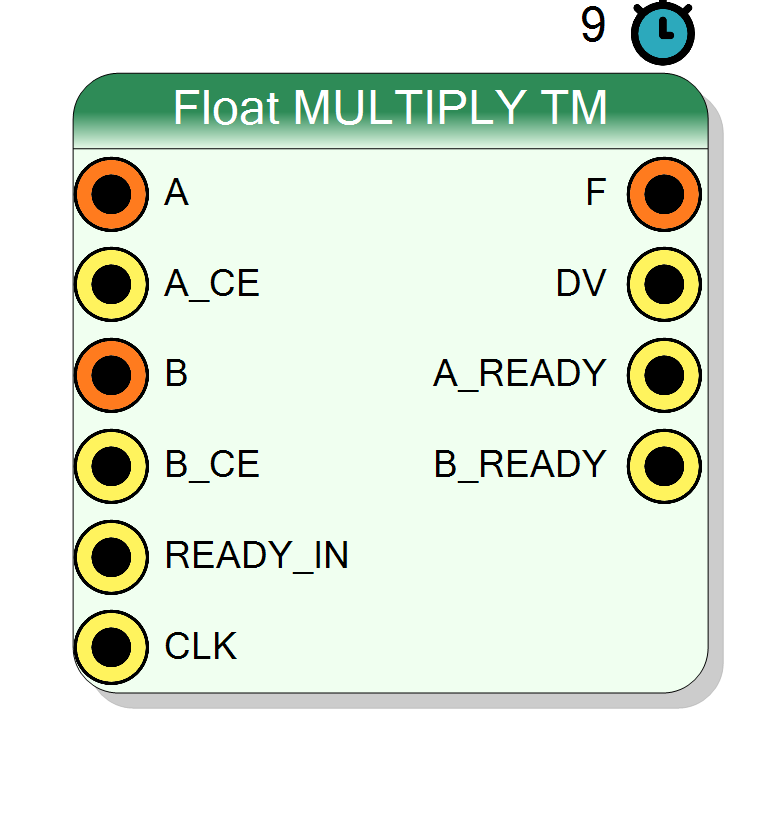
Time-multiplexed floating-point multiplication operator based on Xilinx Floating Point IP. Supports single (32-bit) and double (64-bit) precision, configurable DSP usage, optional TM mode for second operand, and multiple TM phases (1-32) for high-throughput parallel computation in arithmetic processing pipelines.
Introduction
This block performs IEEE 754 floating-point multiplication using the Xilinx Floating Point IP core. The component supports Time Multiplexing (TM): multiple parallel computation units (phases) share the same clock cycle, enabling high sample rates with predictable latency.
On every rising edge of CLK, if A_CE = 1, B_CE = 1, and READY_IN = 1, the operator performs
$$ \mathrm{F}(n) = \mathrm{A}(n) \times \mathrm{B}(n), $$
where all operands are IEEE 754 floating-point values. The TM Factor property determines how many parallel instances are instantiated.
Pin Description
(Exponent + Mantissa) × TMFactor
Floating-point input B.
- If B is TM = YES: TM bus of width same as A
- If B is TM = NO: Scalar replicated to all phases
Properties
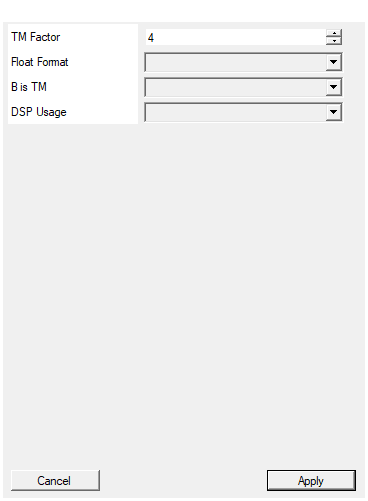
Time Multiplexing factor (number of phases)
Number of time-multiplexed phases (1 – 32).Default: 4
Range: 1 – 32
Select between single precision 32 bit and double precision 64 bit
Floating-point format:
Single→ 32-bit (8 exp + 24 mantissa)Double→ 64-bit (11 exp + 53 mantissa)
Default: Single
Options: Single Double
Select if input B is Time Multiplexed or the same for all phases
YES→ B is TM (each phase gets its slice)NO→ B is scalar (replicated to all phases)
Default: YES
Options: NO YES
DSP Usage. Single precision: No [0], Medium [1], Full[2], Max[3]. Double precision: No[0], Medium [9], Full[10], Full[11]
DSP slice usage:
No_Usage,Medium_Usage,Full_UsageSingle: No [0], Medium [3], Full[4] Double: No[0], Medium [11], Full[16]
Default: Full_Usage
Options: No_Usage Medium_Usage Full_Usage Max_Usage
Functional description
The component wraps the Xilinx Floating Point IP (operation type: Multiply)
and replicates it N times (where N = TM Factor) to support time-multiplexed
data streams.
Input modes
- Input A is always TM, with width
(Exponent + Mantissa) × TMFactor - Input B can be either:
- TM mode (B is TM = YES): Same width as A, each phase gets its slice
- Broadcast mode (B is TM = NO): Single value replicated to all phases
Output
- Output
Fis always TM, with the same width as input A
Mathematical background
IEEE 754 floating-point multiplication with proper rounding and special case handling:
$$ x \times y = \text{round}(x \times y) $$
Special cases:
- $x \times 1 = x$
- $x \times 0 = 0$
- $\infty \times 0 = \text{NaN}$
- $\infty \times x = \infty$ (for finite $x \neq 0$)
- $\text{NaN} \times x = \text{NaN}$
Timing
The Xilinx Floating Point IP has a fixed latency of 9 clock cycles per phase:
| Property | Latency (clock cycles) |
|---|---|
| Multiplication | 9 |
DSP Usage
- Single precision: No [0], Medium [3], Full[4]
- Double precision: No[0], Medium [11], Full[16]
Typical use cases
- Gain control and scaling
- FIR filter tap multiplication
- Complex number multiplication
- Power calculations
- Modulation