
Rayleigh Noise
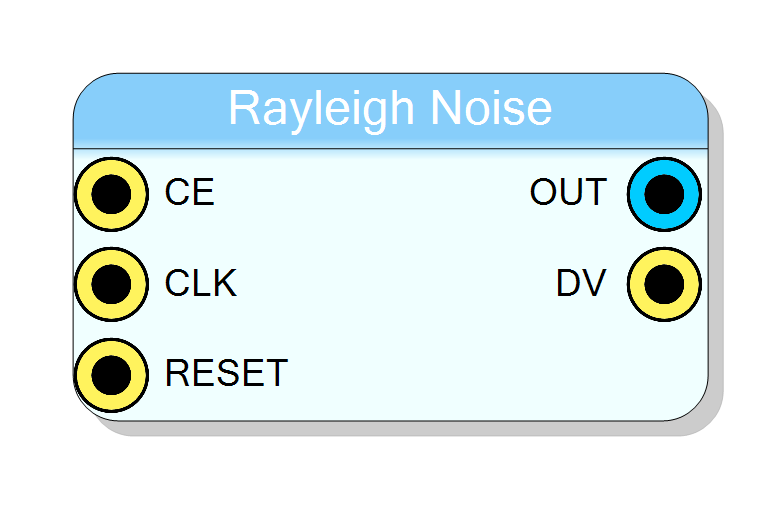
Rayleigh-distributed noise source, one sample per CE clock: OUT = sqrt(-2 ln u) * 2^FractBits (unsigned, saturated), sigma = 2^FractBits LSB. Datapath: CLZ + log2 LUT + constant multiply + exact integer square root – 5-stage pipeline, II=1. Embedded xoshiro256** source with auto-random per-instance seed.
Introduction
Every CE clock the block outputs
$\sqrt{-2\ln u}\cdot 2^{F}$: a Rayleigh distribution with mode
$\sigma = 2^{F}$ LSB and mean $1.2533,\sigma$ – the envelope statistics
of narrowband Gaussian noise (fading emulation, envelope detectors,
magnitude of complex noise).
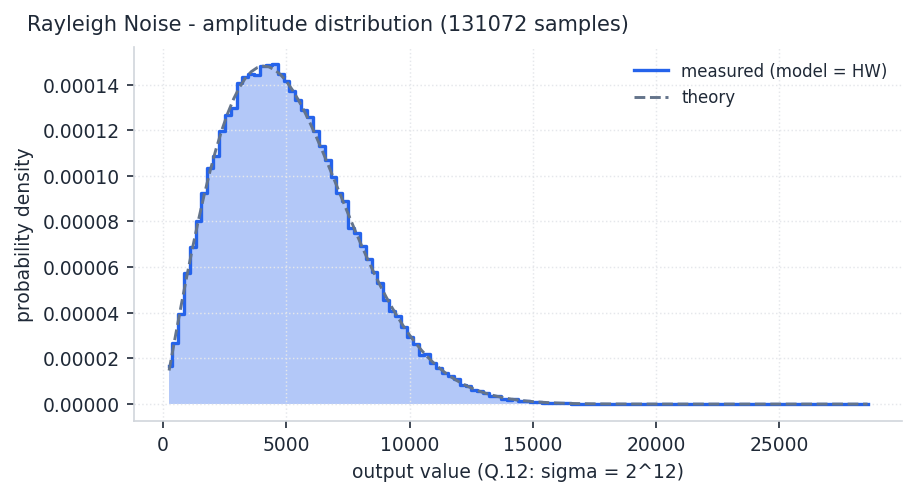
The histogram is measured on the bit-exact model the hardware is verified against (GHDL golden regression); the dashed line is the analytic Rayleigh PDF.
Pin Description
Properties
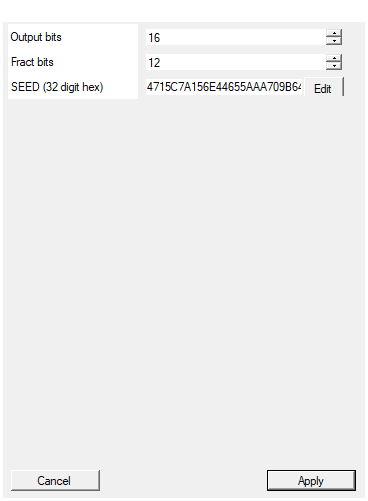
Width of the OUT word (2..32), UNSIGNED, saturated.
Output width (2..32), unsigned, saturated.Default: 16
Range: 2 – 32
Output Q format: OUT = sqrt(-2 ln u) * 2^FractBits. The distribution SIGMA is 2^FractBits LSB.
Output Q format (0..16): sigma of the distribution = 2^FractBits LSB.Default: 12
Range: 0 – 16
Seed of the embedded white generator (128 bit hex), expanded internally with SplitMix64. Auto-randomized when the component is created, so multiple instances produce independent noise; editable for reproducible runs. RESET restarts the sequence. Rayleigh distribution: OUT = sqrt(-2 ln u)*2^FractBits, unsigned, sigma = 2^FractBits LSB.
128-bit seed of the embedded white generator (auto-randomized at placement, editable).Default: 4715C7A156E44655AAA709B64219BD7E
Usage
Latency 5 CE-clocks (DV marks valid outputs), throughput one sample per
CE clock. The integer square root is exact (floor). RESET restarts the
sequence; CE defaults to ‘1’.