
Blue Noise
Blue noise source, +3 dB/octave, one sample per CE clock: the first difference of an internal Voss-McCartney pink source (differencing adds +6 dB/oct to pink’s -3). No multipliers, no BRAM. Auto-random per-instance seed, RESET restarts the sequence.
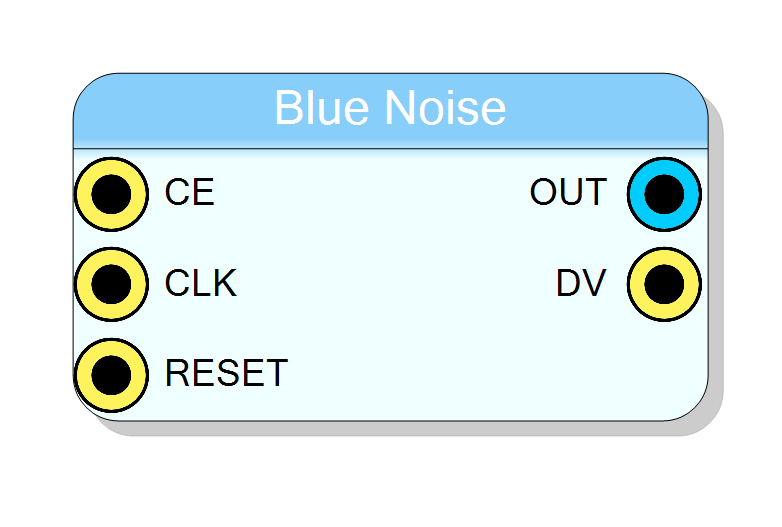
Introduction
Blue noise rises at +3 dB per octave: power concentrated at high frequencies, the preferred dither/error-diffusion spectrum. It is built as $b[n] = p[n] - p[n-1]$ where $p$ is an internal Voss-McCartney pink total: the first difference contributes $+6$ dB/oct, on top of pink’s $-3$, giving $+3$ dB/oct over the covered octaves.
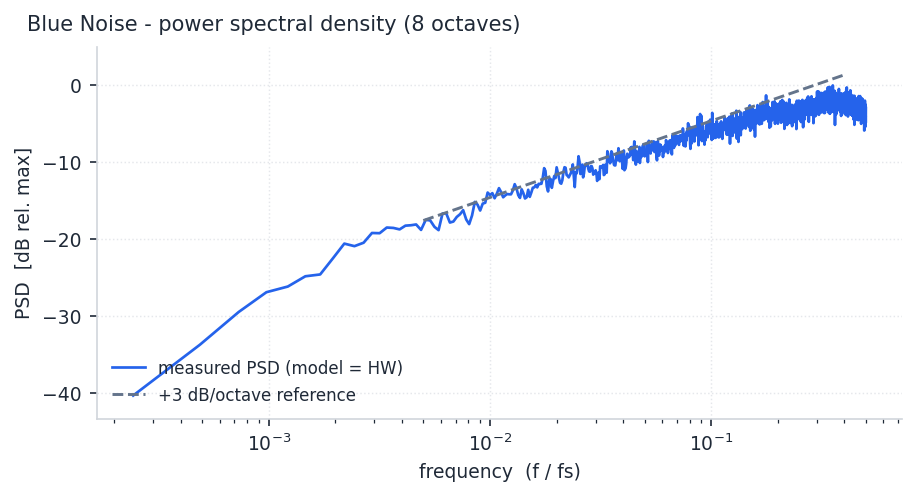
Measured on the bit-exact model the hardware is verified against; the dashed line is the ideal +3 dB/octave slope.
Pin Description
Properties
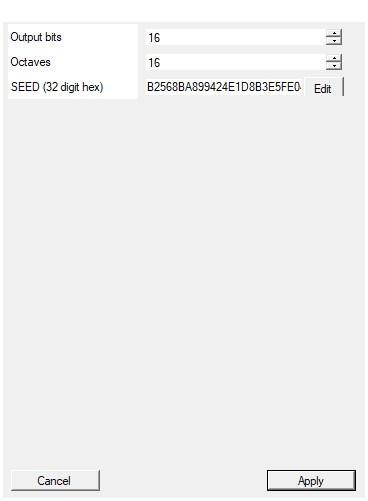
Width of the OUT word (2..32), signed.
Output width (2..32), signed, saturated.Default: 16
Range: 2 – 32
Octave registers of the internal pink source: the +3 dB/oct slope holds from fs/2 down to fs/2^Octaves.
Octave registers of the internal pink source (4..24): +3 dB/oct holds from fs/2 down to fs/2^Octaves.Default: 16
Range: 4 – 24
Seed of the embedded white generator (128 bit hex), expanded internally with SplitMix64. Auto-randomized when the component is created, so multiple instances produce independent noise; editable for reproducible runs. RESET restarts the sequence. Blue noise, +3 dB/octave (first difference of an internal pink source).
128-bit seed of the embedded white generator (auto-randomized at placement, editable).Default: B2568BA899424E1D8B3E5FE04259FF38
Usage
Output normalized (shift) and saturated to OutputBits; one sample per
CE clock, one clock latency. CE defaults to ‘1’.